
Leadership Listening: The Game That Shapes Culture
Here’s a question worth asking: Why do smart leaders, with good intentions, create organizations where people can’t tell the truth?
The answer lives at an unexpected intersection. Game theory – the mathematics of strategic choice – reveals what happens when people must decide between honesty and safety. And that decision, made thousands of times a day in hallways and meetings, is shaped by a single leadership behavior: how you listen.
Leadership listening is the practice of listening to learn rather than listening to protect one’s existing assumptions or authority. It is a foundational capability in modern leadership development and leadership coaching.
The question isn’t whether you’re a good listener. The question is: are you listening to protect your worldview, or listening to learn what’s actually happening?
That difference determines which game your organization plays.
The Game You Didn’t Mean to Start
Every organization runs on games, whether leaders admit it or not. Not the fun kind. The kind game theorists study – situations where people make strategic choices based on what they think others will do.
The most famous is the Prisoner’s Dilemma. Two people are arrested. Each can either cooperate (stay silent) or defect (betray the other). If both cooperate, they both get a light sentence. If both defect, they both get a heavy sentence. But if one defects while the other cooperates, the defector goes free while the cooperator gets the maximum penalty.
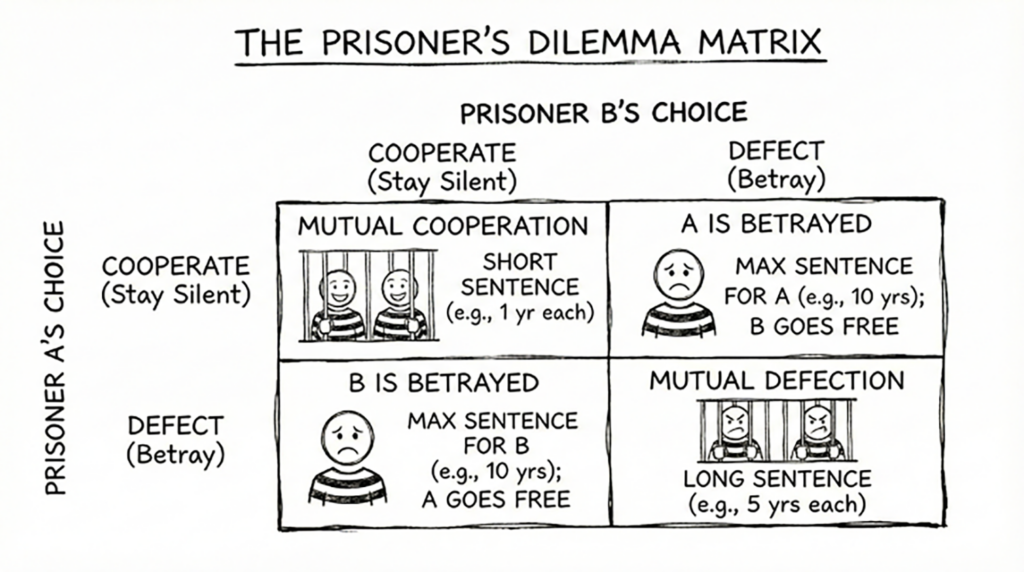
The rational move? Defect. Always. Even though cooperation would benefit both.
Now translate this to your organization:
- Cooperate (be honest): “I’ll share the mistake so we can learn.”
- Defect (self-protect): “I’ll hide the mistake to avoid blame.”
If everyone cooperates, the organization learns and adapts.
If everyone defects, the organization stagnates.
But here’s the trap: if one person is honest while others protect themselves– or worse, if one person is honest and gets punished – the lesson is immediate and permanent.
The system teaches people that honesty is dangerous.
And once that lesson is learned, cooperation becomes irrational. The game shifts from “how do we create value together?” to “how do I protect myself?”
The signal that flips the switch? How leaders respond when people tell them difficult truths.
The Paradox Leaders Create Without Knowing It
Organizations are full of well-intentioned contradictions. Most leaders don’t even notice they’re creating them.
Consider this common scenario:
The explicit message: “I want you to be autonomous. Take initiative. Don’t wait for permission.”
The implicit reality: bonuses, promotions, and reputations depend on flawless execution and following established processes.
The result: employees face an impossible choice. Taking initiative means risking failure, which threatens their security. Not taking initiative means disobeying the stated directive.
It’s a no-win game. And over time, people stop playing. They learn to perform initiative while actually complying and innovation becomes theater.
Gregory Bateson, the anthropologist, called these “double binds.” When the stated rule contradicts the enforced rule, people get trapped between them.
Here’s what makes it worse: leaders genuinely believe they’re being clear. They announced the new value. They put it in the slide deck. They talked about it in the all-hands meeting.
But announcement doesn’t change the game. Structure does. Incentives do. And most powerfully, what happens in the moment when someone actually takes a risk.
That moment – when someone tells you something you don’t want to hear – is when you’re deciding which game your organization plays.
Two Games, One Choice
Let’s be specific about the games.
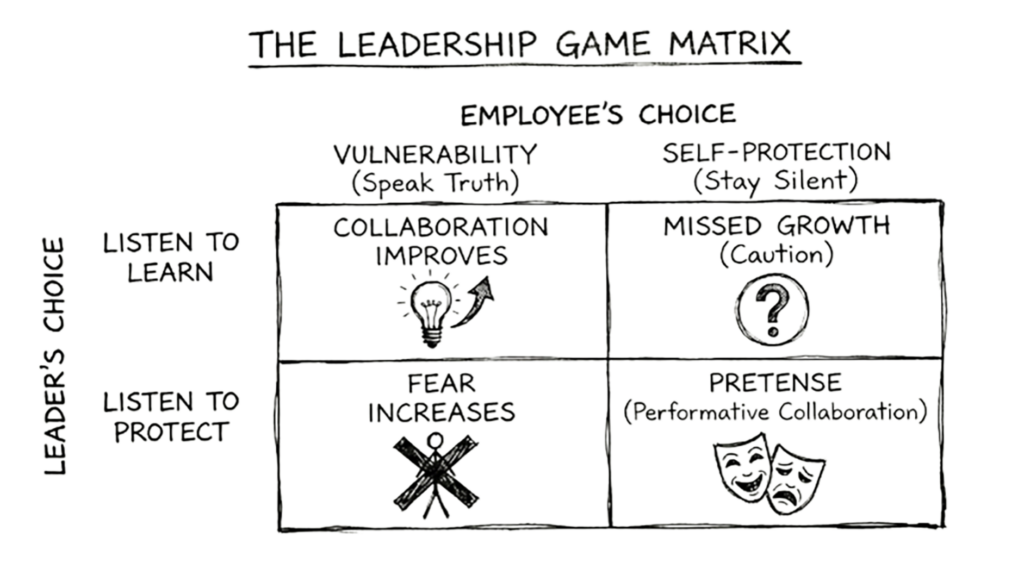
Game One: The Short-Term Survival Game (Listening to Protect)
When leaders listen to protect, they’re defending their identity, their authority, or their existing mental model.
The logic: “I want honest feedback…as long as it doesn’t challenge my core assumptions about how things work.”
What it looks like in practice:
- Someone raises a concern about a strategic initiative. The leader explains why the concern isn’t valid.
- A team member points out a contradiction in stated values versus actual behavior. The leader gets defensive.
- Data contradicts the leader’s hypothesis. The leader questions the data quality rather than the hypothesis.
The leader may genuinely believe they’re being open. But the system experiences something different. People learn what not to say.
In game theory terms, this is a repeated game where defection has been rewarded and cooperation has been punished. The rational response is to stop sharing uncomfortable truths.
The system settles into a stable but toxic equilibrium:
- Leaders don’t get real information
- People don’t tell the truth
- Everyone knows this
- Everyone pretends otherwise
This is what we call Pretense – not as individual lying, but as a system state. It’s the organization playing a game where truth is too expensive.
Game Two: The Long-Term Learning Game (Listening to Learn)
When leaders listen to learn, they prioritize accuracy over comfort. They treat contradictions as valuable data, not threats to their authority.
This capability sits at the heart of emotional intelligence in leadership and is a defining skill in effective leadership development.
What it looks like in practice:
- “That’s fascinating. What happened that has you see it that way?”
- “I’m realizing my assumptions may be wrong here. Help me understand.”
- “This contradicts what I believed. Let’s figure out what we’re both missing.”
The leader isn’t just being nice. They’re changing the payoff structure of the game.
In game theory terms, this is sending a credible signal that cooperation (honesty) is safe and valued. When that signal is consistent over time, rational players shift strategy. Honesty becomes the higher-payoff move.
The system shifts to a learning equilibrium:
- Real information surfaces
- Problems get solved faster
- Innovation becomes genuine, not performative
- Trust accumulates instead of depleting
Over time, this is what creates true psychological safety and sustained workforce engagement.
The shift happens at the speed of conversation. Every response teaches people what’s safe to say next time.
The Expensive Signal
Economists talk about “costly signals”: actions that are hard to fake because they require real sacrifice.
A peacock’s tail is a costly signal. It’s metabolically expensive to grow and maintain, and it makes the peacock more vulnerable to predators. That’s precisely why it’s a reliable signal of genetic fitness. If it was cheap to fake, it wouldn’t mean anything.
Listening to learn is a costly signal in leadership.
It requires:
- Acknowledging your view is limited
- Changing your mind publicly
- Prioritizing truth over ego
- Searching for something to learn when bad news arrives
That might sound expensive. But that’s exactly why it changes the game.
When leaders consistently demonstrate they can handle difficult truths without punishing the messenger, they send a credible signal that cooperation is safe. And credible signals change behavior.
The cheaper signal – saying “my door is always open” or “we value transparency” -doesn’t work. It’s too easy to fake. People have heard it before and learned that the stated rule doesn’t match the enforced rule.
The system learns from behavior, not from announcements.
Practical Moves: How to Change the Game
If you recognize your organization is stuck in the protection game, here are specific actions that shift the equilibrium:
1. Meta-communicate the contradiction
Don’t hide organizational paradoxes. Name them directly.
“I realize our incentive structure rewards individual performance while our strategy requires radical collaboration. That’s a real tension. Let’s talk about how to navigate it.”
Naming the game changes the game. It moves the conversation from listening to protect to leadership listening that supports real organizational learning.
2. Run safe-to-fail experiments
Stop debating whose mental model is right. Design small tests and learn from outcomes.
“We disagree about whether this will work. Rather than argue, let’s run a two-week pilot with Team A and see what we learn.”
This shifts from defending positions to testing hypotheses – a fundamentally different game. Going full on the mantra “good enough for now and safe enough to try.”
3. Separate facts from explanations
When someone brings you difficult information, resist the urge to explain it away.
Instead: “What exactly happened? What did you observe?” (Facts)
Then: “What’s your theory about why?” (Explanations)
This moves the conversation from the speed of opinion to the speed of learning.
4. Reward productive failure
When someone takes a smart risk that doesn’t work out, celebrate the learning publicly.
“This didn’t produce the outcome we hoped for, but now we know X and Y, which saves us from much bigger mistakes down the road.”
This sends the signal that cooperation (trying new things and sharing results) has higher payoff than defection (playing it safe and hiding failures).
5. Track your own reactions
Notice when you feel defensive or dismissive. That’s the moment you’re about to teach the system whether honesty is safe.
The choice isn’t about being right. It’s about whether you want a system that can learn.
The Leadership Algorithm
Leadership, at its core, is a decision tree that plays out thousands of times:
If listening to protect:
→ Ego is validated
→ Information is filtered
→ Silence increases
→ The system becomes brittle
→ Game: short-term survival
If listening to learn:
→ Mental models update
→ Real information surfaces
→ Voices emerge
→ The system adapts
→ Game: long-term value creation
The glitch in the system isn’t a technical problem. It’s not a process failure or a structural issue.
The glitch is that leaders are inside the system they’re trying to lead. Every response, every reaction, every micro-moment of how they handle uncomfortable information – these are not outside the game. They are the game.
You can’t mandate trust. You can’t policy your way to psychological safety. You can’t measure your way to honesty.
But you can change which game is rational to play.
And that choice happens in a single moment: when someone tells you something you don’t want to hear, and you decide whether to protect or to learn.
That’s the game. That’s the choice.
How you choose to listen is how you choose to lead.
Ready to Strengthen Leadership Listening?
At Conversant, our leadership development and executive coaching programs help leaders build the listening capability that drives trust, learning, and performance.
About the Author
Ryo Penna
Consultant
Ryo Penna is a global facilitator at Conversant, based in São Paulo, Brazil, who helps leaders transform everyday conversations into engines of clarity, trust, and results. A TEDx speaker on the wisdom of questions, Ryo’s experience includes leading a 25,000-member student association – his crash course in high-scale, high-impact leadership – and launching multiple businesses as a serial entrepreneur, where he learned that, in the end, it all comes down to how people interact and lead. What he loves most is watching people unlock their potential not by necessarily working harder, but by connecting better and smarter. Outside of work, he runs a secret one-table speakeasy at home, passionately follows soccer, and writes about AI, behavior, and all things human. Ryo helps leaders and organizations thrive through conversations that connect people, purpose, and results. He works as a speaker, global consultant at Conversant, entrepreneur, and researcher, and holds a master’s degree in Prosperity from University College London.