The World Is Round. Communication Is Squared.
Why precision isn’t the enemy of nuance, it’s how nuance survives the trip

Think about the last time you experienced something extraordinary, something so well-executed it stopped you mid-thought. You could feel every detail, every layer.
Now try to explain it so someone else could recreate it exactly.
You can’t. Not fully.
This is the core challenge behind many leadership challenges today. The world we experience is nuanced, layered, and continuous. But communication, the tool leaders rely on to drive employee engagement and workforce engagement, is structured, simplified, and discrete.
And that gap? It’s where misalignment, missed expectations, and disengagement begin.

Why Leadership Struggles with Clarity
The reality is: leaders don’t deal in simple systems. They operate in complexity: relationships, competing priorities, and shifting expectations. These are not linear problems.
They are human ones.
Strong leaders develop a deep, intuitive understanding of situations over time. This is where emotional intelligence in leadership becomes critical. It allows leaders to interpret nuance, manage tension, and navigate ambiguity.
But here’s the challenge:
That understanding must be translated into clear communication.
And that translation is rarely perfect.
Without clarity, even the best employee value proposition or growth strategy can fail to connect. Teams don’t disengage because they don’t care; they disengage because what’s expected of them isn’t fully understood.
Learn how to strengthen clarity through leadership development programs.
The Hidden Breakdown in Workforce Engagement
Language is digital. And digital is square. It has edges, corners, boundaries. A sentence starts and ends. A number is one thing and not another. A deadline is Tuesday or Wednesday. There’s no “the feeling of Tuesday-ness shading into Wednesday” in a project plan.
This isn’t a flaw in language. It’s the nature of the medium. To communicate at all, you have to take something round – your full, felt, contextual understanding of what matters – and press it through the square grid of words, numbers, categories, and commitments. You have to give the round thing edges so it can travel from your mind to someone else’s.
Every workplace interaction follows a pattern:
- A leader holds a complex, nuanced understanding
- They communicate it in simplified terms
- Another person interprets and reconstructs that meaning
The problem? That reconstruction is never identical.
This is one of the most overlooked barriers to workforce engagement.
When clarity is low:
- Expectations drift
- Trust erodes
- Performance suffers
Not because of incompetence, but because of interpretation.

The Clarify Conversation: A Leadership Multiplier
In Conversant’s Cycle of Value, the Act conversations are where shared ideas become individual commitments. There are three: Engage, Clarify, and Close. Engage connects the person to the purpose – why this matters, why them. Close asks for an explicit promise. But Clarify is the one that governs how carefully you digitize the analog – how faithfully you square the round thing before you hand it off.
High-performing leaders don’t just communicate more, they communicate better.
They focus on clarity.
In practice, this means answering three essential questions:
1. What’s at stake?
Define the purpose. Why does this matter now?
This aligns work to meaning, one of the strongest drivers of employee engagement and career growth.
2. Why this person?
Clarify ownership. Why are they the right fit?
This reinforces confidence, accountability, and supports inclusive leadership by recognizing individual strengths.
3. What does success look like?
Define outcomes. What needs to happen, by when, and how will it be measured?
This eliminates ambiguity, one of the biggest contributors to frustration and disengagement.
See how this approach comes to life in the Cycle of Value framework.
Where Leadership Often Goes Wrong
Picture this. A leader takes on a new project and asks an experienced colleague for support. “Since you have so much experience with this technology, I’d love your support on this.” The colleague replies: “Absolutely, you have my support.”
Five words. One of the crudest squares you can cut from a round reality. It sounds clear. But it’s not.
To one person, that might mean active involvement.
To another, it might mean passive approval.
This disconnect highlights a fundamental issue in leadership challenges today:
We mistake simplicity for clarity.
In reality, vague communication undermines:
- Employee engagement
- Trust
- Execution
Read more about avoiding misalignment in common leadership communication mistakes.

The Role of Emotional Intelligence in Leadership
Clarity isn’t just about being specific, it’s about being aware.
Leaders with strong emotional intelligence recognize:
- What hasn’t been said
- What may be misinterpreted
- Where assumptions are forming
They don’t rely on “common sense” or shared understanding. They validate it.
There’s an even deeper issue impacting workforce engagement: unspoken expectations.
People often expect things like:
- Recognition without asking
- Support without defining it
- Career advancement without clear conversations
These expectations are real, but invisible.
When they aren’t communicated, they can’t be met.
And when they aren’t met, employee engagement suffers.
The Clarify conversation is partly a discipline against this kind of invisible waste. Not because it forces people to voice every unspoken desire – that would be its own disaster – but because the habit of precision surfaces the gap between what we think we communicated and what we actually put into words. The first move in Clarify is always a confrontation with your own assumptions: have I actually said this, or do I only think I have?
Learn how to surface hidden expectations through inclusive leadership training.
Four Levels of Leadership Commitment
Conversant’s Conversation Meter – which maps communication from pretense through sincerity, accuracy, and authenticity – becomes something new when you read it through the round/square lens. It becomes a measure of how faithfully you squared the round thing:
Not all communication is created equal. Leaders operate at different levels of commitments behind promises:
The sincere promise is a sloppy square. Well-intended, honestly cut but disconnected from conditions, constraints, and partners. The person squared their enthusiasm rather than their reality. Those who promise sincerely tend to talk big and deliver little. Not from dishonesty, but from squaring the wrong round thing: their aspiration rather than their situation.
The accurate promise is a careful square. Cut with attention to conditions, expectations, outcomes, relationships, and resources. The person did the hard work of looking at their full round understanding and compressing it with as little distortion as possible. Precise enough that the receiver can reconstruct something that genuinely resembles the original.
The authentic promise is something more than a square. It’s a commitment to keep checking whether the square still fits the round. The person invests themselves so fully in the purpose being served that they don’t just encode carefully once, they keep recalibrating. Has reality changed? Has the landscape shifted? Do I need to re-cut? The source of confidence isn’t the plausibility of the promise. It’s an unwavering commitment to keeping the square honest.
The most effective leaders operate in the last two levels. These reflect the highest qualities of leadership: integrity, awareness, and adaptability.

Precision Is What Drives Engagement
There’s a common misconception that too much structure kills creativity or nuance. The opposite is true. Precision is what allows nuance to survive.
When leaders communicate clearly:
- Teams align faster
- Expectations are understood
- Trust strengthens
- Employee engagement increases
See how clarity fuels results in our 2026 Leadership insights.
The Bottom Line: Clarity Is a Leadership Advantage
The best leaders understand something simple but powerful:
You can’t eliminate complexity, but you can communicate it better.
And in today’s environment, where leadership challenges are increasingly human, not technical, that skill matters more than ever.
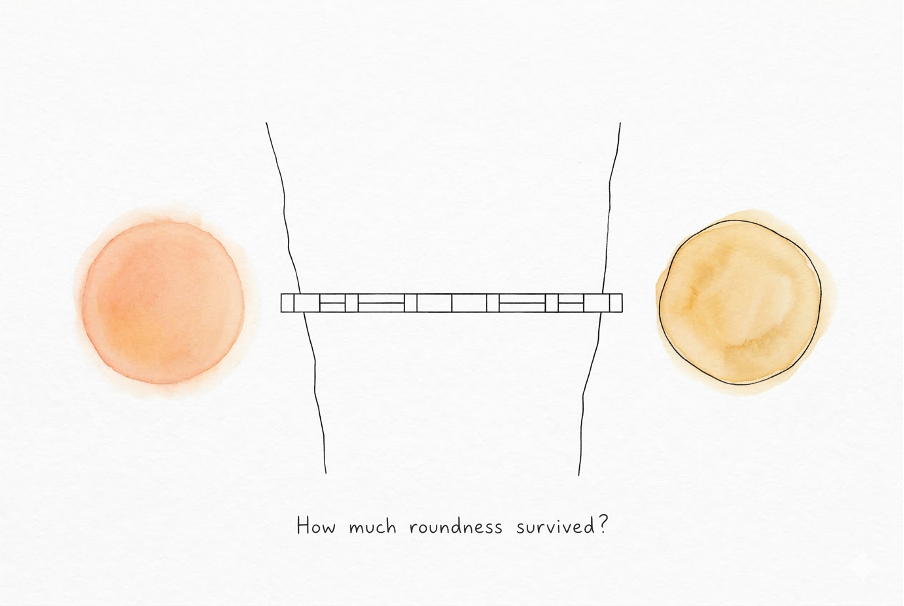
The Clarify conversation lives in the tension between the two. It says: yes, you have to square the round thing. Language requires it. You cannot transmit the full richness of what you know and feel. But you can square it with care. You can specify what’s at stake, why this person, and how you’ll know it worked. You can cut the square carefully enough that the person on the other end has a fighting chance of rebuilding something that resembles what you actually meant.
That’s not bureaucracy. That’s not micromanagement. That’s recognition that your inner world and mine are fundamentally different analog realities, and that words – digital, squared, full of edges and corners – are the only bridge we have.
The world is round. Communication is squared.
The question is how much roundness survives the crossing.
About the Author
Ryo Penna
Consultant
Ryo Penna is a global facilitator at Conversant, based in São Paulo, Brazil, who helps leaders transform everyday conversations into engines of clarity, trust, and results. A TEDx speaker on the wisdom of questions, Ryo’s experience includes leading a 25,000-member student association – his crash course in high-scale, high-impact leadership – and launching multiple businesses as a serial entrepreneur, where he learned that, in the end, it all comes down to how people interact and lead. What he loves most is watching people unlock their potential not by necessarily working harder, but by connecting better and smarter. Outside of work, he runs a secret one-table speakeasy at home, passionately follows soccer, and writes about AI, behavior, and all things human. Ryo helps leaders and organizations thrive through conversations that connect people, purpose, and results. He works as a speaker, global consultant at Conversant, entrepreneur, and researcher, and holds a master’s degree in Prosperity from University College London.