
LEADERSHIP IS ALWAYS HAPPENING: HOW FEEDBACK AND CHOICE ACCELERATE ITS DEVELOPMENT
We often treat “leadership” as a rare set of skills that only certain people possess or can learn through structured trainings. But in truth, all of us practice leadership every day, both consciously and unconsciously. Leadership is, at its core, about influencing the behavior of others and the course of events—and whether we realize it or not, we do that every time we communicate, solve problems, make decisions, or collaborate with others.
If that’s so, then what does formal “leadership development” truly offer? The answer is feedback and choice. When we combine continuous feedback with the power of deliberate, purposeful choice, our everyday leadership becomes more intentional and accelerates real growth. It’s no longer an unconscious influence on those around us; instead, it’s focused and purpose-driven.
LEADERSHIP AS AN EVERYDAY PRACTICE
We tend to imagine leadership as formal authority or dramatic moments—CEOs making speeches, generals at the helm, star athletes rallying the team. But we overlook the simple, repeated ways we influence people around us.
In daily conversations, even mundane decisions (“Should we use Teams or email?”) or casual suggestions (“Have you considered…?”), we’re nudging or guiding others. That’s leadership, albeit often unintentional. Real leadership lives in everyday moments:
- Asking questions that reframe a problem
- Setting the tone in a meeting
- Suggesting a new approach
- Choosing curiosity over control
Why “Unintentional” Leadership Matters
- We shape how colleagues perceive priorities.
- We influence emotional tone (from positivity to stress).
- We redirect the flow of tasks with offhand remarks or actions.
Because these acts happen so routinely, the growth opportunity lies in making them intentional—and that’s where feedback and choice come in.
TWO CRITICAL LEVERS: FEEDBACK & CHOICE
Imagine your everyday leadership as a car already in motion. You’re steering and accelerating, even if you haven’t realized it. Then these two levers—feedback and choice—are like adding real-time navigation plus a deliberate destination. Suddenly, your driving (i.e., your leadership) becomes clearer, more strategic, and more effective.
Feedback:
- This is how you gather insight on whether your current actions are creating value or waste. It could be:
- Direct feedback from peers (“When you do X, it helps me achieve Y” or “I feel overlooked when…”).
- Reflection on your own experiences (“Did my last decision actually move the team forward—or create confusion?”).
- Timely data from results (e.g., metrics, meeting outcomes, or project health checks).
Choice:
- This is the deliberate moment when, with new insights, you decide how to adapt or continue. You align your behaviors with a clear purpose and desired outcomes. Without conscious choice, your leadership remains haphazard, shaped by habit rather than vision.
APPLYING “THE CYCLE OF VALUE” TO LEADERSHIP DEVELOPMENT
At Conversant we apply the Cycle of Value: Align → Act → Adjust.
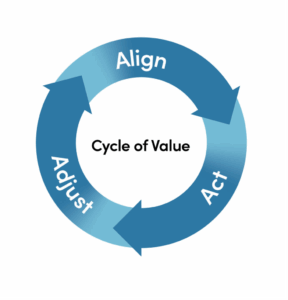
It shows how people create high-value outcomes through intentional conversation and coordination.
We can apply that same cycle to the daily practice of leadership development by focusing on how we “Align, Act, Adjust” with respect to feedback and choice:
- Act
- In a leadership context, Act is actually a given. You’re already “doing” leadership—communicating, decision-making, guiding. Even doing nothing is an action. The question is whether your actions are wasteful or valuable.
- So here, Act represents the existing behaviors you exert daily that influence others.
- Adjust
- This is where feedback In the original cycle of value, “Adjust” calls for timely reviews of results and honest discussions of what worked or didn’t. For leadership development:
- Feedback from Others: “What did you notice when I stepped in to solve that conflict? Was it helpful? Did it clarify or confuse?”
- Self-Reflection: “What was I feeling or thinking? Did I stay calm and purposeful, or was I reactive?”
- There are some Adjust questions you might ask yourself, like:
- “What actually happened here? How close was it to my intended outcome?”
- “What feedback am I hearing from colleagues or data points?”
- “What specific lessons or next steps emerge for me?”
- This is where feedback In the original cycle of value, “Adjust” calls for timely reviews of results and honest discussions of what worked or didn’t. For leadership development:
- Align
This corresponds to choice. When you “Align” in the cycle of value, you identify a purpose or direction.
- For the leader, that means:
- Setting your purpose (e.g., “I want to create a trusting, innovative environment”).
- Determining your desired outcome (e.g., “We need to ship this product in four weeks while keeping morale high”).
- Choosing your next leadership behaviors based on that purpose and outcome.
By reconnecting to purpose and shared goals, you’re aligning your future actions. Instead of defaulting to habit or external pressure, you make a conscious leadership choice.
When you choose intentionally (Align) and then get feedback and self-reflection (Adjust), while already acting, you create a powerful development loop.
WHY CHOICE & FEEDBACK ARE OFTEN OVERLOOKED
It’s one thing to recognize that choice (aligning to a purpose) and feedback (opportunities to learn and adjust) drive leadership development. It’s another to see how the quality of the conversations you can have about them really happen and how.
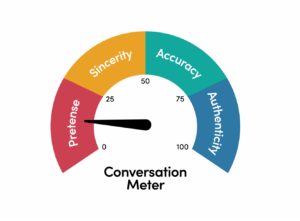
The Conversation Meter highlights four levels of quality and openness in conversation:
- Pretense – People appear engaged but actually hide or distort their real thoughts and feelings.
- Sincerity – They genuinely share, but conversation may still be self-focused or lacking deeper inquiry.
- Accuracy – The group values precise, specific input and strives for factual clarity.
- Authenticity – Everyone brings full candor and vulnerability to co-create solutions and shape shared meaning.
Many leaders, even well-intentioned ones, unwittingly default to the pretense level when it comes to feedback and choice. And that’s exactly why these two elements are often overlooked: we’re going through the motions instead of tapping into genuine dialogue.
Feedback at the Pretense Level
What it Looks Like:
- Superficial check-ins: “We good?” “Everything’s fine, right?”
- Ritualistic 360-reviews or formal performance reviews with minimal candor.
- Leaders appear to seek input, but the real aim is to confirm their own existing opinions.
Result:
- Teammates sense the leader isn’t truly listening. Feedback is either sanitized or withheld.
- The “conversation” is more like box-ticking, creating no real learning or trust.
Choice at the Pretense Level
What it Looks Like:
- The leader “asks” for input on the path forward but has already decided.
- The question “What do you all think?” is posed, but no matter the responses, the leader does what they planned anyway.
Result:
- Team members feel their opinions don’t matter.
- The leader’s “choice” is a sham, so future buy-in and engagement fall dramatically.
EVOLVING FEEDBACK & CHOICE UP THE CONVERSATION METER
Below are practical illustrations of how both feedback and choice can move beyond pretense to sincerity, accuracy, and finally authenticity—and how that upgrades your ability to truly listen and shape conversations.
LEVEL 2: Sincerity
- Feedback: You genuinely invite people’s perspectives (“What did you like or dislike about that meeting?”). You listen but still within your own lens. If the feedback stings, you may become defensive or quickly explain why you did what you did.
- Choice: You sincerely consider team input before deciding, but you may be swayed heavily by personal preference or top-down pressure. There’s an earnest attempt to weigh others’ ideas, but deeper alignment on purpose may remain shallow.
How to Improve:
- When feedback feels uncomfortable, pause and reflect instead of immediately justifying yourself.
- Share a quick, sincere reaction: “I appreciate you speaking up; let me think on that more carefully.”
LEVEL 3: Accuracy
- Feedback: You not only welcome input but also seek clarity and specifics: “Can you give me an example of when my direction created confusion?” You paraphrase to ensure you heard correctly, and the dialogue becomes more precise and actionable.
- Choice: With better data, you consciously weigh how each potential action aligns with the stated purpose. You confirm key stakeholders’ concerns and do some quick cost–benefit analysis. The final decision is clearly grounded in accurate information, not assumptions.
How to Improve:
- Ask clarifying questions: “When you say this approach ‘slowed us down,’ do you mean it caused extra tasks or blocked you from starting?”
- Before finalizing a choice, restate your understanding of others’ viewpoints: “So here’s the route I’m leaning toward, because it meets X goal. Did I capture your concerns correctly?”
LEVEL 4: Authenticity
- Feedback: You openly and willingly invite real-time correction and deeper honesty: “Please call me out if you see me backtracking on our shared values. It really helps.” You also share your own self-reflections: “I realize I might be micromanaging, this is new territory for me.” Feedback becomes a co-created learning experience.
- Choice: You align your decisions deeply with personal and shared purpose, then transparently explain why you’ve chosen a path even if it’s risky or vulnerable. Others see not just the what of your choice, but the why behind it, building trust and understanding.
How to Improve:
- Show vulnerability by acknowledging uncertainties or mistakes: “I might not have the perfect solution, but I’m choosing this path because it aligns with our mission to innovate even under constraints.”
- Invite the team to keep you accountable: “If you sense I’m ignoring feedback in the future, I give you permission to call me aside and let me know.”
PUTTING IT INTO PRACTICE
Use the Conversation Meter to evolve your everyday leadership conversations:
- Recognize the Pretense Indicators: Stop treating feedback as a chore; stop offering “fake choice” that’s already decided.
- Aim for Accuracy: Ask better questions, reflect on what you hear, articulate how each viewpoint influences your decisions.
- Embrace Authenticity: Invite candor, share your own thought process, and show genuine openness to course correction.
By continuously raising feedback and choice from pretense toward authenticity, you unlock higher levels of trust, more accurate data for decision-making, and ultimately more purposeful, value-creating leadership. When you truly listen (not just hear) and shape (not just dictate) conversations, you accelerate your own growth—and everyone else’s.
Leaders are not forged only in executive courses or formal roles; they’re created every day in the small but constant ways we influence those around us. Since action is already happening, the real question becomes: How will you integrate timely feedback and deliberate choice into your daily leadership?
By actively seeking feedback (from peers, direct reports, and your own reflection) and choosing purpose-driven actions that align with clear outcomes, you transform unconscious everyday leadership into a potent, value-creating practice.
Over time, this virtuous cycle (Act → Adjust/Feedback → Align/Choice → Act) keeps compounding your growth as a leader—and positively shaping the results and relationships in your organization.
Ready to develop everyday leadership across your organization?
Conversant helps leaders build trust, clarity, and meaningful collaboration through everyday conversation. Learn more about our leadership development programs: https://www.conversant.com/services/leadership-development/
About the Author
Consultant
Ryo Penna is a global facilitator at Conversant, based in São Paulo, Brazil, who helps leaders transform everyday conversations into engines of clarity, trust, and results. A TEDx speaker on the wisdom of questions, Ryo’s experience includes leading a 25,000-member student association – his crash course in high-scale, high-impact leadership – and launching multiple businesses as a serial entrepreneur, where he learned that, in the end, it all comes down to how people interact and lead. What he loves most is watching people unlock their potential not by necessarily working harder, but by connecting better and smarter. Outside of work, he runs a secret one-table speakeasy at home, passionately follows soccer, and writes about AI, behavior, and all things human.