Emotional Intelligence in Leadership: The Human Edge AI Can’t Replicate
By Kell Delaney Global Partner, Senior Consultant & Executive Coach, Conversant
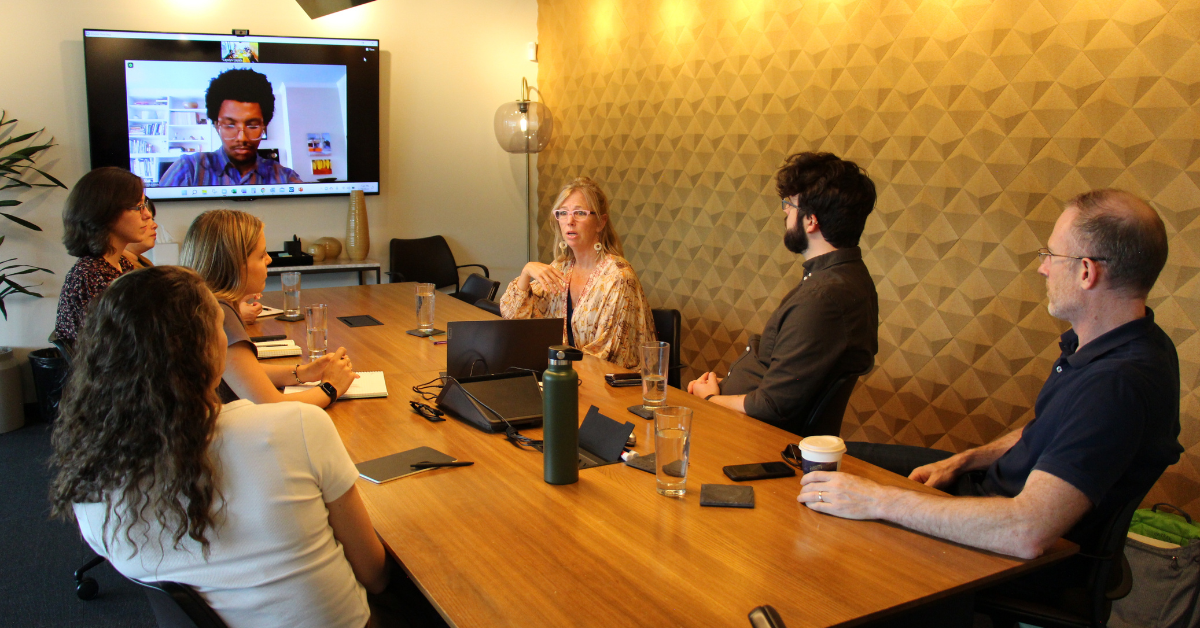
A few years ago, I was with three colleagues in the Midwest, facilitating a three-day in-person session with a client. We explored ideas we weren’t sure would work, and watched our clients surprise themselves when they did. It was one of those experiences that reminds you why this work matters.
Recently, I found myself thinking about what had actually created the conditions for that session to go the way it did. It wasn’t the agenda. It was the quality of attention, of care, of willingness to stay present in the discomfort rather than move past it. A level of emotional intelligence that had taken each of us years to develop.
I’ve been writing about AI and emotional intelligence since 2023, a topic that has grown more urgent and more interesting since then. AI tools are no longer a curiosity for most leaders. They’re part of the daily fabric of how we work. And that changes the question we need to be asking.
The question today is: what does genuinely human leadership look like in a world where so much cognitive work can be automated?
The Capability AI Is Accelerating
I use AI tools regularly. Most of the leaders I work with do too. They’re extraordinary at synthesizing large amounts of information quickly and pattern recognition across datasets. These capabilities are useful and time-saving.
But emotional intelligence in leadership is a key capability that AI has not been able to replicate.
Emotional intelligence in leadership: the ability to read what’s actually happening between people, to stay regulated under pressure, to build genuine trust, to ask the question that shifts everything, to sit with someone’s discomfort long enough that something real can emerge.
Emotional intelligence is arguably some of the hardest work in leadership, and in my experience, it’s the work that most directly determines whether a team or an organization can move through real complexity together.
What Emotional Intelligence in Leadership Actually Looks Like
There’s a temptation to describe emotional intelligence in abstract terms like empathy, self-awareness, and social skills. While those terms are accurate enough, I think they can obscure what this actually looks like in practice.
It looks like a leader who notices that the room has shifted. When the energy shifts after a certain topic was raised, when someone who usually speaks up has gone quiet, and who makes a choice to slow down and find out what’s there rather than push forward.
It looks like someone who can stay curious. Who can receive tough feedback as information rather than an attack. I’ve watched leaders with high technical intelligence and strong strategic instincts hit ceilings in their effectiveness because they couldn’t do this one thing. And I’ve watched others with more modest analytical skills lead teams through extraordinary challenges because they could.
It looks like the ability to be genuinely (not performatively) present. This sounds simple. It isn’t. In a world of constant distraction and relentless task pressure, full presence is increasingly rare. And when a leader offers it, people feel it.
It looks like the willingness to be vulnerable. To say “I don’t know,” to acknowledge a mistake, to share what’s genuinely difficult, to speak from the edge of their own understanding rather than always from the place of certainty. Counterintuitively, this is what builds trust faster than almost anything else.
None of these capacities can be prompted, generated, or optimized by AI. They’re developed through experience, reflection, feedback, and the hard work of growing a more complex relationship with oneself.
The Risk I’m Watching
Here’s what concerns me as AI becomes more deeply embedded in leadership: not that AI will replace leaders, but that leaders will unconsciously use it to avoid the work that matters most.
When we rely too heavily on neat, synthesized, AI-generated summaries, we may stop developing the patience to listen for the thing that wasn’t said. When analysis is instant and abundant, we may stop sitting with the discomfort of not-knowing long enough to develop genuine judgment.
The Sailboat and the Algorithm
I often think about the analogy of a sailboat in a harbor. Problem-solving (what AI does brilliantly) is about lifting anchors. Finding what’s holding us back, diagnosing constraints, removing obstacles. It is necessary and valuable work.
But lifting every anchor in the harbor still leaves you bobbing in the same spot. Wonder is what actually gets the boat moving. And once the boat is moving toward something that matters, you find you have new energy to deal with the remaining anchors, because you can see them in relation to the destination.
AI is an extraordinary anchor-lifting machine. It is not, and I don’t believe it can be, a compass. That still has to come from the quality of our imagination, our connection, our capacity to care about something beyond the optimization of what already exists.
The leaders I see thriving right now are not the most AI-fluent. They are the ones who can bring genuine presence, curiosity, and commitment to the people and problems in front of them. AI makes their work more efficient. It doesn’t make them who they are.
To learn more about developing these capacities in yourself or across your leadership team, I invite you to explore Conversant’s leadership development programs.
A Question Worth Sitting With
I’ll leave you with the question I’ve been sitting with lately, because I think it’s more useful than any framework I could offer:
Where in your leadership are you allowing the convenience of a tool to substitute for the quality of your attention?
That question doesn’t have a tidy answer. But I think the willingness to ask it, honestly, is itself an act of emotional intelligence.
For a deeper conversation on the specific skills that differentiate leaders in the AI era, listen to my recent episode of On Connection: Leadership Differentiators in the Age of AI.
About the Author
Global Partner, Senior Consultant & Experience Designer
As a Partner at Conversant, Kell Delaney coaches individuals, teams, and organizations to recognize the strengths they already possess and apply them to the challenges they face. With 13 years at Conversant and an MA in Communication, his work bridges group dynamics, meaningful dialogue, and the future of human-centered leadership. He also works on complex, multi-stakeholder initiatives that require deep collaboration across boundaries to address global-scale issues. Kell believes that in an AI-driven world, it’s our uniquely human qualities—connection, imagination, and wonder—that will shape the future. In his free time, Kell loves playing outdoors with friends—hiking, biking, running, and skiing—as well as savoring great conversations, long walks, and time for reading and reflection.