
Why Your Best Teams Are Quietly Burning Out (It’s Not the Workload)

Ryo Penna
Ryo Penna

Subscribe to our Newsletter, The Conversation

Why Your Best Teams Are Quietly Burning Out (It’s Not the Workload)

The one meeting where effort turns into learning is, on most calendars I see, the first to get cancelled.

By Ryo Penna

Blog Overview

Workforce burnout is often a problem of meaning rather than hours. Tait Shanafelt’s study of 465 physicians found that those who spent at least a fifth of their week on the work they found most meaningful were burned out far less often, at 29.9 percent versus 53.8 percent. Teams that run on pure execution face a version of the same problem, because no one ever sees what the effort produced. This article lays out a seven-question review conversation, supported by research on debriefs from Scott Tannenbaum and Christopher Cerasoli, that closes the loop. Used on a schedule, it strengthens team development, improves employee engagement, and gives managers a practical form of leadership development.

“We do not learn from experience… we learn from reflecting on experience.”

Most leadership rooms have heard some version of that line, and I have yet to watch anyone argue with it. People nod. Some write it down. Then the meeting ends, everyone goes back to a calendar made entirely of execution blocks, and the sentence they just nodded at has no slot anywhere on it. No owner, no date. The same team that agrees at 9am cancels its own review before lunch. A client called. The quarter was ending. Reviewing felt, in the moment, like a thing teams with less work get to do. Nobody was lying when they nodded. The calendar just beat them.
This gap, between a sentence everybody believes and a practice almost nobody keeps, bleeds two things at once. Learning is the obvious one. Workforce burnout is the one that took me longer to see.

Effort that loses sight of its effect

Christina Maslach built the instrument most burnout research still runs on, and what she and Michael Leiter describe is a chronic mismatch between a person and their work, in six possible areas, of which workload, the one everyone assumes, is only one. Values is another, and it covers the slow widening of the distance between what someone does all day and anything they recognize as mattering. The cynicism their burnout profile measures turns out to be closer to detachment than to exhaustion: people still doing the work while the meaning drains out of it, which no amount of vacation fixes. Leaders who treat workforce burnout as a scheduling problem are addressing one cause out of six.

Here is the number that convinced me. Tait Shanafelt asked 465 doctors at one academic hospital a simple question: how much of your week goes to the part of your work you find most meaningful? Then he measured burnout in the same group. Among doctors who gave at least a fifth of their week to that meaningful part, 29.9 percent were burned out. Among those below it, 53.8. And this one variable predicted burnout better than total hours worked did. It is one hospital and a correlation, so hold it loosely. A near doubling is still hard to ignore.

Translate that from one doctor to a whole team. A group locked in pure execution never reaches the moment when anyone can see what all that effort did. What did last month’s push actually produce? Did it teach anyone anything? Nobody can say, because no conversation exists in which somebody would have to answer. When a team tells me there is no time to stop and review, I believe them, and then I notice the same team finding time to redo work, to relitigate a decision from March, and to recruit replacements for the people who quietly gave up and left. Each departure is the end point of employee engagement that faded months earlier.

Why you cannot think your way out of this

The first fix anyone proposes is personal: reflect more, slow down, think harder about your mistakes. Daniel Kahneman, who won the Nobel in economics for showing how far human judgment strays from the rational ideal, spent fifty years explaining why that barely works.

Start with his most famous distinction. Almost all of our thinking runs fast and automatic; the slow, deliberate kind that could audit a month honestly is effortful, scarce, and runs down as the day goes on, which is why the leader who chaired a careful 9am meeting waves through a weak proposal at 6pm with equal confidence. And when the slow kind does review the past, the past has already been edited. Knowing the outcome changes what we remember about the decision: mistakes now look like they were obviously mistakes, and lucky bets look like skill.

One of his findings explains something every manager has felt. Performance swings around a person’s average on its own: after someone’s worst week they tend to improve whether or not you intervene, and after their best week they tend to slip back. Kahneman watched flight instructors live this. They shouted after bad landings and saw improvement; they praised good landings and saw decline; so they concluded that shouting works and praise backfires. Both changes would have happened anyway. Years of unstructured reviewing teach a leader exactly that wrong lesson.

Late in his life, working with Olivier Sibony and Cass Sunstein, he documented a second problem: we are not even consistent with ourselves. The same person judges the same kind of case differently at 10am and at 4pm, in rain and in sun. At one insurance company, executives guessed their underwriters would differ on a price quote by about 10 percent. Then they measured. The real difference ran around 50 percent, between colleagues with the same training, sitting in the same building. The remedy the three of them proposed is deliberately unglamorous: fixed sequence, independent inputs, structure.

And that is the point to carry forward. Kahneman was explicit that organizations can correct bias better than individuals, for one reason only: an organization can impose a procedure, while an individual has intentions. A tired brain cannot audit itself, and no course changes that. So stop relying on the brain. Take the slow thinking out of the head and rebuild it as a structure, something a team walks into on a schedule, on a date that does not depend on anyone feeling wise that day.

Where that structure lives

In Conversant’s Cycle of Value, the work of a team moves through three kinds of conversation. Think of the cycle as team development built into the work itself. Align conversations settle what we are doing together and why, and what we will commit to it. Act conversations put promises into motion: who owes what to whom, by when. And Adjust is the turn of the wheel that most teams skip: the conversation where the cycle closes, experience gets converted into learning, and the next cycle starts better informed than the last one.
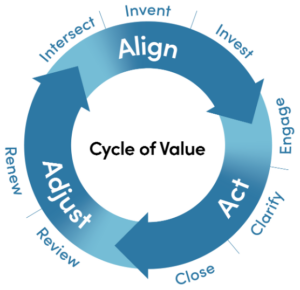
Look at where most teams actually live on that wheel. They align occasionally, act constantly, and adjust almost never, which leaves the cycle permanently open: effort flows out, and nothing comes back around to say what the effort did. An open cycle is the team-sized version of Shanafelt’s doctors below the line. All output, no visible effect.

The Adjust turn is one conversation with two movements, and they only work together. Review looks backward: what did we promise, what actually happened, what does the gap teach. Renew turns forward: given what we now know, what do we commit to next. Separate them and each one dies. A review without renewal is an autopsy, interesting and useless. A renewal without review is a guess wearing a plan’s clothes. Richard Rianoshek, who co-created the method, used to refuse the term post-mortem for this conversation, preferring acceleration reviews, on the theory, which the data below bears out, that stopping to adjust is how a team speeds up.

Two design choices carry most of the weight.

  1. The conversation fires from a trigger list, not from anyone’s mood. Results beat expectations, results missed them, a routine milestone arrived, or the ground shifted under the team. Half that list has nothing to do with failure, which is the point; a team that only adjusts after disasters has taught itself that adjusting is what punishment looks like.
  2. The conversation examines the work and leaves the character of the people who did it alone. Open an adjust conversation on what went wrong and within minutes every brain in the room has flipped to defense; from then on people trade explanations, not facts, and whoever explains loudest wins. The sequence below exists so nervous systems stay open long enough for facts to get a hearing.


Does structure really beat effort here, or is that consulting poetry? Scott Tannenbaum and Christopher Cerasoli pooled 46 studies of debriefs covering 2,136 people, and the ones who debriefed outperformed the ones who did not by somewhere between 20 and 25 percent, in field settings as much as simulations, for teams and for individuals working alone. The detail worth rereading: the gains concentrated where the debrief was structured and aligned, meaning the format did the work, not anybody’s willpower. The dose can be absurdly small, too. In a study Giada Di Stefano ran with Francesca Gino, call center trainees who spent the last 15 minutes of each day writing about what they had learned beat colleagues who spent those same minutes doing extra practice, by about 20 percent.

Fifteen minutes of looking backward outperformed fifteen minutes of more doing. If you only remember one experiment from this piece, make it that one.
The protocol

The version we use has seven questions in a fixed order. The first five look backward, the last two turn forward, and the protocol does not let a team leave with only half the conversation done.

  1. What is the purpose of our work? What results have we promised? Without this anchor, groups answer an easier question than the one they face. And if the team struggles here, you have learned something expensive early: there was never alignment to begin with.
  2. Accurately, what has happened to date? Observable facts, before anyone’s explanation of them, because whoever leads with an explanation recruits the facts into its defense, and then the review is over without having happened.
  3. What worked well? Not politeness. Opening on failure flips the room into threat, and a threatened brain protects instead of learns, so the sequence pays for the honesty of question four in advance.
  4. What was harder than it needs to be? Friction gets named without culprits getting named, and problems surface while they are still cheap.
  5. Who is there to appreciate, and specifically for what? This one looks soft and is the most mathematical of the seven. Left to statistics, appreciation goes extinct, since regression guarantees praise looks like it backfires. Putting it in the sequence is how it survives.
  6. What will we do to improve? The output is a specific behavior with an owner’s name on it. “We need to communicate better” does not qualify and the facilitator’s job is to say so.
  7. What is our most important focus for improvement before our next review? One focus, chosen together. And the word “next” does quiet scheduling work: the following conversation is now assumed rather than argued for.


The tip: schedule these BEFORE a project starts so people know that this is happening regardless of the results.

What the Adjust gives back

The backward half of the conversation restores the learning. The forward half, I have come to think, restores the thing this piece opened with. When a team closes by choosing its own next commitment, effort reconnects with effect in public: people watch their work produce a consequence and then decide what follows, instead of receiving both from above. Shanafelt’s physicians needed a fifth of their time connected to meaning before the burnout curve bent. A team buys its version of that fifth for an hour a month, and the wheel starts turning again instead of lying open. It also doubles as leadership development, since a manager who runs it well practices asking and listening in front of the whole team.

The quote at the top of this piece hangs on posters in a thousand training rooms. The calendar invite does not. Workforce burnout builds quietly, and a standing review is among the cheapest early defenses a leader has. Send the invite.

Frequently Asked Questions

What is workforce burnout?

Workforce burnout is a chronic mismatch between people and their work. Christina Maslach and Michael Leiter describe it across six areas, and workload is only one of them. Another is values, the distance between what someone does all day and what they recognize as mattering. Burnout of this kind often resembles detachment more than exhaustion, so a vacation rarely resolves it.

Not according to the research cited here. In a study of 465 physicians at one academic hospital, Tait Shanafelt found that time spent on the most meaningful part of the job predicted burnout better than total hours worked did. Doctors who gave at least a fifth of their week to that work were burned out at a rate of 29.9 percent, against 53.8 percent for those who gave less. It is one hospital and a correlation, so the finding is a signal and not a verdict.

A structured review lets a team see what its effort produced and decide what to do next. Scott Tannenbaum and Christopher Cerasoli pooled 46 studies of debriefs and found that those who debriefed outperformed those who did not by 20 to 25 percent, with the largest gains where the debrief was structured. Because people watch their work produce a result and help choose the next commitment, effort reconnects with meaning, which is the link employee engagement depends on.

Schedule the first one before a project begins, so everyone knows it will happen regardless of results. In Conversant’s method, the conversation fires from a trigger list: results beat expectations, results fell short, a routine milestone arrived, or the ground shifted under the team. A manager can facilitate it with the seven-question protocol, about an hour a month, which also serves as leadership development because the leader practices asking questions and listening in front of the team.

About the Author

Ryo Penna
Consultant

Ryo Penna is a global facilitator at Conversant, based in São Paulo, Brazil, who helps leaders transform everyday conversations into engines of clarity, trust, and results. A TEDx speaker on the wisdom of questions, Ryo’s experience includes leading a 25,000-member student association – his crash course in high-scale, high-impact leadership – and launching multiple businesses as a serial entrepreneur, where he learned that, in the end, it all comes down to how people interact and lead. What he loves most is watching people unlock their potential not by necessarily working harder, but by connecting better and smarter. Outside of work, he runs a secret one-table speakeasy at home, passionately follows soccer, and writes about AI, behavior, and all things human. Ryo helps leaders and organizations thrive through conversations that connect people, purpose, and results. He works as a speaker, global consultant at Conversant, entrepreneur, and researcher, and holds a master’s degree in Prosperity from University College London.

Featured Resources

collective intelligenceorganizational leadershiphuman-centered leadershiploveleadership developmentcommunicationcollaboration
On Connection Podcast Episode 85 - Designing Love Into Work with Marcus Buckingham
podcastNewsconnected leadershipleadership developmentconversationcommunication
On Connection, a podcast by Conversant
middle managementhuman-centered leadershipemerging leadersconnected leadershipleadership development
The Future of Middle management On Connection Episode