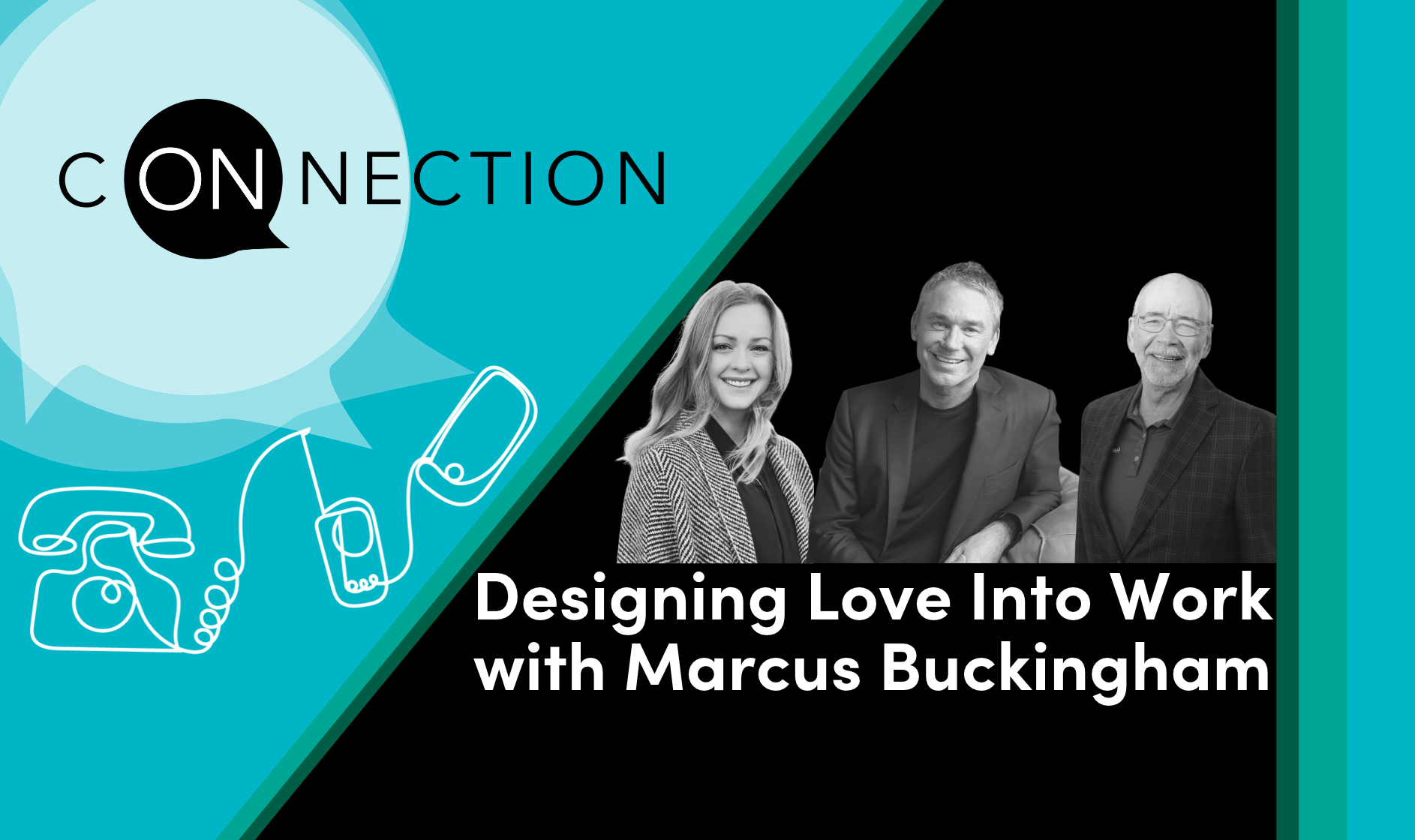
Designing Love Into Work with Marcus Buckingham
Why does love belong in conversations about leadership and performance? Marcus Buckingham joins Mickey Connolly and Emma Rose Connolly to explore the strengths, experiences, and human needs that help people do their best work.
In this episode, you’ll discover:
- Why Marcus Buckingham believes love is one of the most powerful and practical forces in business.
- How leaders can identify the activities that genuinely strengthen and energize people.
- The connection between strengths, performance, and human potential.
- The five feelings that shape experiences people love.
- How leaders can create environments where people feel known, supported, and able to grow.
About This Episode
What if love is one of the most practical forces in business?
Marcus Buckingham joins Mickey Connolly and Emma Rose Connolly for a conversation about leadership, strengths, performance, and the conditions that allow people to flourish at work.
Drawing on decades of research and the ideas behind his latest work, Design Love In, Marcus explores why leaders should pay closer attention to the experiences people naturally love. Those experiences often reveal where individuals feel strongest, most energized, and most capable of making their greatest contribution.
Together, they examine how leaders can better recognize strengths, support growth, and create workplaces where people feel known, supported, energized, and able to become more of who they are. They also discuss the five feelings behind experiences people love and why those feelings matter for leadership, engagement, and performance.
Whether you lead a team, develop leaders, coach others, or shape organizational culture, this conversation offers practical insights into helping people thrive.
About Our Guest
Marcus Buckingham is the author of two of the best-selling business books of all time, has three of Harvard Business Review’s most circulated, industry-changing cover articles, and has been the subject of in-depth profiles in The New York Times, Wall Street Journal, USA Today, Forbes, Fortune, Fast Company, The Today Show, and The Oprah Winfrey Show.
Known as the world’s most prominent researcher on strengths, love and leadership at work, Marcus’s data-based discoveries are unlocking the best in each of us and defining the future of how we work. He is the author of eleven business books, and his latest release —Design Love In is now the core of his mission. He is dedicating the next decade to helping individuals and organizations unleash the most powerful force in business: love.
Learn more about Marcus’ recent work.
Try This Leadership Practice
Notice what strengthens someone. In your next one-on-one conversation, ask: “Which parts of your work leave you feeling energized and wanting more?”
Listen for specific activities rather than broad responsibilities.
Pay attention to where people describe feeling absorbed, excited, curious, or effective. Those moments often reveal strengths that may otherwise go unnoticed.
As Marcus shares in this conversation, understanding what strengthens people can help leaders create conditions where performance and growth naturally follow.
The Five Feelings Behind Experiences People Love
Marcus Buckingham’s current work explores the feelings that frequently show up when people describe experiences they genuinely love.
As you listen, consider:
- Which feelings show up most often for members of your team?
- Which are consistently absent?
- What leadership practices help create more of them?
These questions can open productive conversations about engagement, performance, strengths, and workplace culture.
Continue Exploring
Learn more about our upcoming open enrollment leadership development programs.
Subscribe to On Connection on Apple Podcasts, Spotify, or Castbox to discover additional conversations featuring leadership thinkers, practitioners, executives, and change-makers exploring the human side of work.
Transcript
Transcripts are generated by machine learning, so typos may be present.
Emma Rose Connolly (00:05)
Hello and welcome back to On Connection. Today’s conversation is with Marcus Buckingham, one of the most influential thinkers in leadership and workplace performance over the last several decades. Marcus spent nearly 20 years at Gallup studying excellence, engagement, and what great managers do differently. He helped pioneer strengths-based approaches to leadership and went on to write widely read business books on management, talent development, and team performance, including the bestseller First Break All the Rules. One of the central insights running through his work is that excellence is deeply individual. People can work in the same organization, even in similar roles, and have very different experiences of work. One person may feel energized and able to contribute, while another feels stuck or depleted. For leaders, that raises a different kind of question. Not simply how do I get more out of my people, but how do I create the conditions where each person can bring more of themselves and their talents to work? His more recent work brings that inquiry into sharper focus through the language of love. In Love Plus Work, Marcus invites individuals to pay closer attention to the activities that naturally energize them and to shape more of their work around those patterns.
Emma Rose Connolly (01:18)
In Design Love In, he extends that idea to leaders and organizations, making the case that love is not just about personal fulfillment or happiness at work. It’s something leaders can design for, measure, and connect to outcomes like engagement, loyalty, growth, and performance. For most of human history, love and work weren’t necessarily understood as belonging to completely separate worlds. Ancient thinkers wrote about friendship, mutual obligation, and the good life. Christian traditions connected work with love of neighbor. Service and vocation, and later the idea of a calling gave ordinary work a moral and even spiritual significance.
Emma Rose Connolly (02:00)
But something shifted with the rise of modern business. Big surprise. Industrialization, scientific management, and bureaucracy brought enormous emphasis to efficiency, rationality, standardization, and professionalism. The ideal worker was increasingly someone who could separate the personal from the professional, who could perform a role without bringing too much emotion into it. In that world, love became a word that belonged mostly somewhere else, to family, friendship, faith, or private life, not serious business. Love never fully disappeared from the work world, but we did break it into tiny pieces and translate it into safer words.
Emma Rose Connolly (02:42)
Over the last century, we’ve talked about morale, motivation, commitment, engagement, emotional intelligence, psychological safety, compassion, belonging, purpose. Each has brought another part of our emotional and relational lives back into the workplace without necessarily using the word love. And only relatively recently have some leaders and researchers, Marcus, a significant one, begun using that word explicitly again. This is what makes Marcus’s recent work provocative. He’s not arguing that leaders should turn work into a family, erase boundaries, or Make Love a substitute for fair pay, autonomy, or good management. He is asking whether we can name more directly what great leaders and great workplaces have always depended on, whether people feel seen, energized, and able to contribute in the ways that matter.
Emma Rose Connolly (03:33)
In this conversation, Mickey and I are joined by Marcus to explore what it means to design love into work, how leaders give attention, create the conditions for people to contribute through their talents, and connect everyday moments to performance, commitment, and growth. Whether you lead a team of five or an organization of 5000, this conversation offers both inspiration and a practical question. What experiences are you creating every day for the people you lead? Without further ado, here’s our conversation with Marcus Buckingham.
Emma Rose Connolly (04:13)
Hello and welcome back to On Connection. I am joined today by Mickey. He’s back and for a very good reason. We have a very special guest. We’re joined by Marcus Buckingham, who to us is quite a celebrity. So I’m very happy to have you here. Marcus, thank you for saying yes to spending the time with us. You’ve spent decades studying what helps people thrive at work from your first book, First, Break All the Rules. That was the first one, right? Is that right?
Marcus Buckingham (04:42)
That’s true.
Emma Rose Connolly (04:44)
Quite a hit. Sold over a million copies, and Nine Lies About Work, and now the research that you’ve done for both Love Plus Work and your most recent book, Design Love In. And we’re thrilled to get to talk to you about all of it, so especially this most recent work on love, it resonates very deeply with us here at Conversant. But before we get started, just how are you? How has your year been? You’ve got a book out there this year. What’s it been like so far?
Marcus Buckingham (05:09)
Yeah, thank you for having me, Emma Rose. Um, yeah, and hi, Mickey. Uh, as ever. Yeah, it’s been great. It’s books are… Winston Churchill said writing a book is a… A strange, uh, process where you kind of sneak off… to write it in the first parts, and it’s like this guilty… pleasure and then you suddenly turn and discover it’s a monster. It’s wrestling you to the ground. And so the end part of a book is just wrestling and wrestling and wrestling with a manuscript until I think he said that you end up just throwing it out into the public in hopes that it doesn’t take over your life continually the way that it has done. And I always feel like that with every book. It’s like, it starts off and you’re… you’re so, like, entranced with the… the possibilities. And then it grows, and it’s way bigger, and then it just becomes, and it becomes, and it becomes, and it takes over your thoughts, and your heart, and your feeling and everything, and then in the end, you’re like, oh, just put it out in the world. And then you get to talk about it a lot, so it’s actually, uh… Anytime you’re putting a book out into the world is a wonderful opportunity to clarify your own thinking and clarify your own values, frankly. So, it’s been that kind of year. Clarification year.
Emma Rose Connolly (06:40)
Hmm, beautiful. Well, Mickey, what would you say to begin? You’ve talked about Marcus for a number of years as a fan, and just given your impact, Marcus, on this strengths focus to development and growth that’s had a huge impact on Us and our business, but what else would you say is your attraction to Marcus and the work that you’ve gotten to do around him?
Mickey Connolly (07:08)
Well, I’ve… for my entire career. I’ve wanted to gravitate towards the positive in a way to deal with the negative. And… Actually, the first thing that Marcus really had me feel like there was research behind that was when you did now discover your strengths. Boy, I felt like something we had intuitively been doing. Like, go to where you’re strong, and then bring that to the challenge, instead of trying to fix where you’re weak. And I just felt like the research you’d done, the… data and analysis took something that was a gut feel and made it legitimate, which gave… us more confidence in the practice doing what we do. Because I don’t just like unbridled optimism that ignores the harsh reality of life. And what I’ve seen you do… It was later I went back and read First, Break All the Rules, and then, uh, go put your strengths to work, and… Etc, etc. But that you are so grounded in meticulous research, And yet somehow bring that to the actual human experience of being at work. That’s why I’ve been a… admire for some years. And recently, you know, I’ve had the chance to work together, and it’s just deepened it. So that we can somehow marry. rigorous research. With the emotional reality of being human, That’s my idea of fine work.
Marcus Buckingham (09:03)
Well, that’s what that’s where the data takes you, really, isn’t it? It’s like. If it took you in a different place, I think I would have to go there. That’s where I started my career off as a social science researcher working for the Gallup organization. It was all about what are the reliable ways to measure things that you can’t count. So you can count lost work days or you can count accidents on the job, you can count sales. But how do you, how do you measure empathy? We measure competitiveness? How do you measure employee engagement. They’re all really kind of interesting things that any one of us could wax lyrical about. Um, and have opinions about, which is great, we should. But my first mentor was Don Clifton, and he was a… He was a professor in psychology, but he was also professor in applied mathematics. So his whole orientation was around counting things, or figuring out reliable ways to count things that you can’t actually count, which… I was… That’s a bold… that’s a bold inquiry, right? Seriously, like how, you know, you’ve got the MMPI, which is the Minnesota Multivariate Personality Inventory, you’ve got Myers-Briggs, which is sort of an extension of a Jungian archetypes. You’ve got various other personality tests that came out of the military in the… after the Second World War. But we really didn’t have reliable ways to measure the things you’re talking about. We didn’t have a reliable way to measure strengths. Most psychology was pathology, so the DSM is filled with really vivid descriptions of all sorts of diseases and pathologies. That’s great. Like we need to fully understand psychosis and neurosis and so forth, but his perspective, Don Clifton’s perspective, was always, that leaves a big half of life undiscovered. that makes life worth living is joy and meaning and wisdom of fulfillment and love, and they’re not just the absence of depression. or loneliness or isolation. There’s something else. So that was always just fascinating to go, okay, well, if there’s something else in the positive side of life, as you say, Mickey, then how do you measure that? Like, is that a thing? Is that a thing? Okay, well, how would we know if it’s a thing? Can we see whether or not? that people who are most productive in the world spend most of their time. fixing who they aren’t, or do we see, actually, that the most successful people in the world figure out ways to maximize who they are? How would we measure who they are? How would we actually reliably measure the uniqueness of a person? Could we do that? How would we do that? And so that’s, from the get-go, was always, well, I don’t know where this is gonna lead, but let’s follow the data to where it does lead, and then we can start saying some intelligent things about humans at work. Which, before, frankly, before First, Break All the Rules, and I’m sure you’ve read this too, that there was a lot of really good books, but they were mostly, sort of, I did this sort of books. Um, biography kind of books, right? There was the occasional in search of excellence, which was a. fairly rigorous sort of study of excellent companies, I suppose, but there really wasn’t anything that was rigorous around the human experience of working on a team in a company. And so that was… that was kind of where everything started on my end, and it was… It led to some of the things you’re talking about. It led to some of the ideas around strengths, it led to some of the ideas around the human emotional experience at work is a really meaningful and cool thing. Employee engagement is a thing, which then drives behavior. Ooh, what’s that? So it was funny, it was the… It wasn’t that we started with a thing and then found the data, it was we went with the data and then was like, oh, okay, it leads here and here, and here, which… I guess is my… is to do it that way around.
Mickey Connolly (12:57)
When you… Well, and it… yeah, go ahead. Sorry, Emma Rose, when you are talking about that challenge of measuring what is apparently unmeasurable. Measuring what people normally can’t count. How did all that… thinking and experience lead to StandOut? Because you develop your own assessment. And not only the CliftonStrengths Finder and all that stuff that you’ve done. But you stand out to the most recent assessment, isn’t it? did. How did all that research lead you there?
Marcus Buckingham (13:36)
Well, two ways. So the first book was First, Break All the Rules, which really, when you study employee engagement, you start measuring how people feel about work. Basic sort of questions like, does someone care about me at work? Do I know what’s expected of me at work? Do I believe in the mission of the company at work? We find that, first of all, you find that that varies hugely inside the same company. So the very first thing that we came upon ourselves then went, Mickey, was variation. range inside the same company. So, most people talk about companies as having a culture. Here’s the company culture, and there’s books on company culture, and there’s a bunch of, you know, articles about this company’s culture is different than this company’s culture. You go and start measuring culture, and you find that there’s actually more variation within a company than between companies. Or the question, like, do I know what is expected of me at work with a group of people doing the same work? You might have 70% of people strongly agreeing to that question in one team of accountants working for Toyota, and then another team of accountants working for Toyota in the same building down the hall, you’ve got 24% of people strongly agreeing that I know what’s expected of me at work. Okay, the moment you start seeing all of that, you start going, oh… It’s the manager. I’m not saying there isn’t no such thing as culture, but you join a culture. And so that was when we first started going, hey, you join a company, you quit your boss. That came out of variation where there shouldn’t be any. Not where there shouldn’t be any, where you wouldn’t have anticipated that there was variation on such a basic question as, do I know what’s expected? You find there is, where that means, of course, that the person who’s actually running that team of accountants at Toyota Must be a different sort of human than the person running this team of accountants at Toyota, which must lead to people on the team going, oh, my experience of Toyota is mediated massively through the uniqueness of that particular leader. Oh, okay. So goes the leader, so goes the company, which Which sounds obvious, but it’s like at the time that was like… And then, so that’s the first thing, was the manager’s massively important. The second thing, which first led to StrengthsFinderer, was you study the best team leaders, and you find they focus on strength and manage around the weaknesses, which now sounds like motherhood and apple pie, but at the time was like, what? But no, they focus on, you know, you have strengths and areas of opportunity. No, you don’t. strengths and areas for development. No, you don’t. You have strengths which are your areas of opportunity. You have strengths which are your areas for development, and then you have weaknesses. Don’t put the opportunity in the wrong place. That was the mind-blowing thing that the best managers understood. Strengths are places where you’ll grow the most. Weaknesses are where you’ll grow the least. Don’t give them the wrong name. Are you giving them the wrong name? Oh, you still have the wrong name. Hey, Workday. You’ve given everybody the wrong name in every single performance management system you put out. Hey, Oracle. Hey, PeopleSoft, you’ve ruined everyone because you’ve got a whole system in place that does the opposite of what the best team leaders do. You’ve designed performance management systems as those strengths are places where people won’t grow much and weaknesses are where they’ll grow the most. Okay, yeah, completely 180 degrees wrong. In which case, you better start measuring strengths. How do you reliably measure strengths? Well, that’s a psychometric question. We could get into that if you want, but out of that came strength findout. That’s 34 themes of strengths for the individual, the tool, as you know, Mickey, we talk about this, is like fit for purpose. And the purpose of StrengthsFinder was for the individual. How do we help you have a language in a non-bragadocia way for describing the best of you? Strengthfinder was our best effort to do that, which was great. But of course, for a manager, going back to the first discovery that it’s the team leader that makes the huge difference, StrengthsFinder is not a tool for team leaders because if you’ve got 10 people, And they’ve all got 34 themes of talent, at least as measured by Strengthfinder. Then even if you just give them the top five, you’ve got some poor manager trying to juggle 50 different theme combinations, and that makes their life worse, not better. So with Standout, I tried to combine the two discoveries and go, Let’s build a tool For team leaders to get the best out of their team. And one of the tools in the toolbox Was an assessment going we’re going to measure each person on 9 strength roles, I called them, and then give you your top 2 so that as a team leader, it’s shortcut. And the difference between StrengthsFinder and… StandOut with StrengthsFinderers really for the individual, and very much self-assessment. So it’s, do you like to hang out with futurists? Do you like to hang out with historians? Are you more of a teacher? Are you more of a coach? And you would make your pick. Standout, it was what’s called a situational judgment test. threw a situation at you, like… A friend at work posts your ideas off as her own, what would you do? And then we got you to jump. Top of mind jump. And what that leads to, of course, is the results aren’t how you see yourself. They’re how you come across to others. You repeatedly do we don’t give you a clue as to what we’re measuring or what’s the right answer. We just go, boom, boom, boom, boom, boom. So in the end, you end up with a tool in Standout, which lives happily alongside Strengthfinder. They’re just measuring different things. One’s for the individual, Strengthfinder, and once for the manager to try to get to a tool that’s simple enough to capture how does that particular person On your team, How do they actually show up and win and then versus this person versus this person versus this person. And so that was the impetus, really. There aren’t that many tools for team leaders. A bunch of HR tools. ton of HR tools, whether team leaders want to use them or not, is another question, but not very many tools for a team leader going, how do I get the best of my people? So that’s what… that was the impetus for Standout.
Mickey Connolly (19:18)
Emma Rose, I know you’ve recently been reading. last two of Marcus’s books. I’m just wondering. What had you be so. intrigued and glad that Marcus was joining us.
Emma Rose Connolly (19:32)
Oh, well, plenty of reasons, but I mean, this. my affection that has me be in the work that we do at all is just human beings, and how human beings operate, and what makes them feel motivated and fulfilled and we spend a whole lot of our lives at work, and so if work is a way that we’re supporting the life that we want to live in some way, whether we’re finding our fulfillment through that time or elsewhere, and it’s allowing for that, then Why not care about how people feel at work and what engagement looks like there, and how to help it? And I think that leadership has a whole lot to do with that, which makes sense, given what the data is saying. So, and then that you’re somebody who gets to pair this rigor with something that feels like it’s Optimistic about the human condition is really lovely and, I think intriguing, and feels very gratifying for somebody that has that hope that that’s actually what turns out when human beings all gather and try to do something together. Well, and it sounds to me like the data ended up leading you to love, right? And that’s how you tell that story. So was that surprising for you? Was that something that you had a hunch about before? And what ended up being that it was love, L-O-V-E, the word love that came out in this most recent workplace? that you were doing.
Marcus Buckingham (20:57)
Well, it started actually Emma Rose, with, um… It started with what’s the definition of a strength? That’s actually where everything love-related began, because we… we think of a strength as what’s, you know, as an activity you’re good at, and a weakness is an activity you’re bad at. Which has some weird implications to it. One of them is that you’re not really the judge of your strengths or your weaknesses, somebody else’s. So almost immediately, you’re told as a young child, all the way up into the workplace, particularly in the workplace, it’s like you have blind spots, you know, and other people are the judge of you. But also, if you push on that definition of a strength, a strength is what you’re good at, weakness is what you’re bad at, almost immediately, if you’re at all curious, as a manager of people, Um, you bump into a… you bump into a problem. Which is that there are some people that are really, really good at some things they hate. And there’s quite a lot of people that get pigeonholed into doing a bunch of stuff at work that they’re really quite good at, and the manager’s like, hey, listen, we are super busy, I need you just to I need you to step in, like, you’re good at it. And, you know, parents as well, when you’re 16, 17, 18 years old and you’re getting A’s. And your parents are like, no, no, you’re going to do pre-med, man. You are gonna… Mom, I hate biology. Yeah, I don’t. I don’t care, you’re good at. So from a very early age, we kind of, we say your strengths are what you’re good at, weaknesses are what you’re bad at. But of course, if you’re really… If there’s certain subjects or activities or moments or interactions that you dread, that drain you, and you’re really good at them, what’s that? What’d you call that? Because it’d be a strange person to say to somebody, well, that strength, and you should build your career around that. Yes, but I hate it. You ever had to do it again, it’d be a day too soon. Yeah, but you’re really good. So there’s a juxtaposition, or difference, rather, between something that you’re good at and something that brings you deep energy, that’s something that really invigorates you, something that you love. And so when you’ve been pushing that, you realize, oh, it’s the proper definition of a strength is a strength is an activity that strengthens you. Weaknesses and activity that weakens you, even if you’re good at it. No rhyme or reason to that, by the way. Who knows why it is that some people love to color code their sock drawer, and other people, if you even begin to get them to put any organization to the thing that they’re packing in that suitcase, they just come out in hives. Why is that? A race? No, religion? No. Gender? No. A first child? No. No. It’s the random clash of the chromosomes. You know, I have an elder brother and a younger sister. Most of my, I think the initial driver of me getting into this business at all was, and you have, you know, siblings, my brothers are really, really, really good musician, and really different from me, and my sister was a professional ballet dancer, and really different than me. And I yearned, I was a middle child, not… that really matters that much, but… I yearn to be them, and I had the same parents. And I couldn’t speak the language of music. Like, I couldn’t… I can’t… my dad gave me a trombone. will be in this jazz band. Okay, I’ll do that because I can learn stuff. And I couldn’t like he just I just so almost you know from a very early age, you’re like, why is there a difference between me and my brothers and sisters like why that’s weird because you So all the psychology books are really social psychology books. They’re about broad swaths of the human condition in society, whether it’s gender-based or whether it’s religion-based or nationality-based or whatever. But I had a brother and a sister who were wit. I mean… Lovely, but, like, not… not me. So, almost immediately you go, oh wow, a strength is what strengthens you for no good reason. Like, my… I couldn’t argue with my dad. Like, I couldn’t find the words. If I wanted to argue, I… I am not in the middle of a conflict. I… some people become cold and crisp and clear, and their words flow perfectly like a river. I can’t… I can do this. You get into an argument with me? But I turn into a super inarticulate version of me really quickly. It’s the weirdest thing. And so you figure out really early that the language of strength is a language of love. The DNA of your strengths is an activity that you love. And there are signs to it. Before you do it, you lean into it. While you’re doing it, time flies by. The whole Mihaly Csikszentmihalyi flow thing. When you’re done with it, you kind of want to do it again. You pick up on details others miss, you pay attention to things. It’s like, oh, wow! Love is a decoder. It was my, it was like, oh, if a strength is an activity that strengthens you, then what’s the decoder? Oh, it’s what you love. Well, we know that. We just are divorced from that. But we know that. So that long answer to your short question, Emma Rose, but that was where it was first like, oh. If you’re gonna… because if you think about it, and I call them red threads, an activity that you love is a red thread. There’s many activities in your job that you just have to do, and there’s some of them pretty emotionally neutral, black, green. gray, white, whatever. But some of them are red threads, right? And so it was like, oh, what’s cool about that… Is that everyone else is colorblind. To yours. But you’re not. You can see your red threads more clearly no one else can. And we disempower our children so quickly. At school we do it, at work we do it with our employees, we say, you don’t know who you are, you have blind spots, I can see you far better than you can see yourself. I got clear eyes, you’re blind. We don’t say it quite that way, but almost. So the idea of turning that around and going, no, Emma Rose, you are the wisest person in your world, and you were at five. You didn’t have a language for it. And for you to be able to own that power is to begin by going, what you love is really specific and really interesting and is a part of a pattern. It may change or develop a bit as you grow, but love will always be the thing you should scavenger hunt for in your life. You follow a path of love, and I don’t mean necessarily romantic love. I just mean you keep scavenging for activities that you love, who knows where it will lead you, but it won’t be off track. It will lead you to places that are a really beautiful expression of you. Okay, that’s not woo-woo, that’s just real. And it was like, oh, love, love’s many other things, too, which we can get to, but it sure as heck is a decoder of the idiosyncrasy of you, and you have the power to identify it, contribute it, not in a narcissistic way, but in a way that we know when you’re doing an activity that you love, your brain chemistry changes and you’re more open to new information, you’re more open to new collaboration, you’re… Barbara Fredrickson, the positive psychologist, calls it broaden and build. Your brain literally stops the the flight-or-fightness of… which is… can be useful, but when you’re doing an activity you love, your whole brain chemistry changes, and you are smarter. It’s like your brain on drugs looks like an egg in a frying pan, but your brain on love is you at your best, man. So, it would behoove you to know pretty vividly what it is that you love. Because it leads to strengths, doesn’t always like you got to work at it. I’m not saying it’s like, but boy, it’s like Malcolm Gladwell’s 10,000 hours. It’s like, well, okay, Malcolm, but… The question isn’t whether 10,000 hours will help you get better at something. The question is, what do you have an appetite to do anything 10,000 hours for? Appetite. it’s like, where’s the appetite? Well, love is the appetite. So, long answer to a short question, but that’s where it was like, oh man, love is the DNA of strengths, and you own it. That’s so cool.
Emma Rose Connolly (28:47)
It’s so cool. Well, so all that said, and for you having been in this research for as long as you have, why do you think that’s so hard for us to accept and do anything with it? You know, it feels like such a paradigm shift from how Our institutions are structured or how we’re raised, like you’re saying. And why do you think it’s so hard for us to just trust that our experience of I love that moments is the pathway that’s going to lead to not only better outcomes for ourselves, but also for the things we’re contributing to.
Marcus Buckingham (29:20)
Well, and, you know, Mickey and I have talked about this at length for. The pathology that it creates within large organizations, but many large organizations which have come to define the capital holistic world in which we live, the world of work in which we live. um, have a problem with variation. And the… what they yearn for very often is a mechanistic transactionalism, where, like, hey, I’ve got 15… Emergency room nurses. Well, here are the competencies you’re supposed to have as an emergency room nurse. We will measure you against those 15 competencies, which we defined before we met you. We define the job this way. Who you are individually, uniquely, as a person is interesting to us only insofar as it reveals the gaps. between what you should be, In this emergency room nurse definition, and who you actually are. Your uniqueness is a bug. That we need to fix. Most businesses, that’s where now, interestingly enough, you talk to the best managers, the best managers, Putting aside the kind of organizational… pathology that I just described, manages the most defining quality of a great manager is what we came to call individualized perception. Individualized perception means that you live in a world of it depends. And so you ask a great manager, what’s the best way to motivate someone? And you do a really good concurrent validity study. We have a bunch of… you have a study group of 100 really great managers, as defined by the company, people they want to hire more like, and 100 average managers, not terrible, just average. And you do that repeatedly, company by company, study group, contrast, study group, contrast, study group, contrast. And you ask the people in the study group some questions like, what is the best way to motivate someone? What is the best way to help someone learn? And you just list… what is the best way to praise someone? And you just listen to the responses of the study group to see whether or not they speak differently from the contrast group, And similarly, in any way to each other. One of the first things that hits you with those open-ended questions, like I just mentioned, is they all say the same darn thing. All those managers say the same darn thing to those questions I just mentioned, and they all say, it depends. What’s the best way to motivate someone? Well, it depends on the person. Not depends on the job. It depends upon how long they’ve been in the job, not depends on which nationality they are. It depends on that human. Some people need to be in their face shouting at them, and that other people, if you raise your voice even a tiny bit, they shut down. The best managers, you’ll never hear a sentence like, oh, all salespeople are like… it’s like, no, they’re not. Oh, all engineers are like, no, they’re not. The best managers seem to have this individualized perception and they figured out The best way you solve for the bug of individual human uniqueness is the way that we’ve always solved for it. We came up with the technology about 35,000 years ago. That was called a team. And we developed a technology that was like, uh, Marjorie is really good at spotting where the animals are going, and Brian seems to be really good at intuiting how to ford them into this particular area of the step that we’re on, and over here, Brian seems to be particularly brave, albeit sometimes a bit stupid. And we’ll put them together and it’s called a team, and it’s made up of a bunch of unique individuals. The oldest… human cave drawings we’ve ever found, twice as old as the cave drawings in… of France are on the island of Sulawesi, Indonesia. About 42,000 years old, and They only found, like, 2017, like, not very long ago, but it’s a drawing in Oka, red ochre, It’s a drawing of a bunch of animals, is fine that we see that all over. But then a bunch of little humanoids. Which are not quite human, they clearly are human, they’re carrying spears and stuff, but they’ve got animal… Features. One of them’s got the face kind of like a lion. One of them’s got… the tale of, like, a crocodile or something. One of them’s got… and they think, they think, obviously they don’t know, but they think that it’s the artist trying to represent either the spirit animal, or the personality of the different people chasing these animals down. So the earliest human art that we found as yet… Is the painting of a team. That gives me kind of goosebumps, because it’s like… Oh, the quintessence of the human experience is a unique human experience. And you fight against that at your peril. So again, one could go off in 17 different directions around this, but human uniqueness in most companies is a problem to be fixed. And I think one of the ways in which me and Mickey have come together around stuff is, no, it’s not a bug to be fixed, it’s a feature to be maximized. And to your point, if work’s gonna be part of most people’s lives, which for most of us, it is, It ought to be one of those places in which you get to maximize, namely contribute, grow, So your uniqueness. That’s not pie in the sky. It’s what the best team leaders do today. If you don’t know that, dear company, it’s because you don’t know that. It’s not because it’s not true. Anyway, yes, that.
Emma Rose Connolly (34:59)
What? Just that. Yeah, just that.
Mickey Connolly (35:04)
I can get… caught up in Baskin, downright wallow in the notions of a fulfilled human being produces better results than an unfulfilled human being. You know, I can. hang out in that domain for a long time, whether it’s Seligman or you, or who, you know, everybody that’s worked on flourishing. My next question of you… is what’s the real overt case? For caring about the Unique individuals in a big company, you know, a company that’s got 50,000 people or 250,000 people. What’s the case for caring about that relative to the performance of the enterprise or the performance of the could be a not-for-profit, but the performance of the professional community. What’s our clear line between caring about. Designing love into work and the kind of work that gets done.
Marcus Buckingham (36:13)
Well, if you push on it, I mean, this is going to be a funny thing to say, but the challenge with most leaders in most businesses today is their data disfluent. They don’t know from data. And it sounds silly to say so, because it’s like we’re all slave to the CFO, right? Or maybe sometimes the general counsel. But when you think about it, the job of a leader is to change behavior. That’s the job. There’s not seven jobs, there’s one job. You’re the CEO. Your job is to change the behavior of customers and of employees. That’s it. So the question for you as a CEO. Is what is the best way to change human behavior? Well, there’s really just 2 answers to that. Again, there’s not 150 ounces, there’s two answers to that. First answer is, you can change it directively, you can change all the incentives. So for customers, you can have pricing, you can change loyalty programs, like the airlines are doing every other day. Um, with employees, you can change compensation structure. I don’t know, change their rating, I guess. There’s things you can do, you can give them corrective feedback, or whatever. We can do things directively to change human behavior, and that does not work. It does work. Not for a very long time, and not in any way that is super differentiated for that company. So the other way to do it… Which many of the best CEOs understand, is you change experiences. You change the experiences of customers and the experiences of employees, because experiences drive behaviors, drive outcomes. behaviors drive outcomes. If you want sustainably productive outcomes. Well, you better get into the experience business. You better start looking at how do we create sustainably brilliant experiences which drive the behaviors, which drive the outcomes. to get people obsessed. What’s the job of a CEO? Activate obsession. That’s it. Oh, you don’t know that’s your job? Well, it is. Sorry. You’re trying to activate obsession. Customer obsession or employee obsession. Well, if you do that, Mickey, if you study extreme experiences, Just holding that logic, experiences, drive behaviors, drive outcomes. Okay, and we all sort of know what that’s like in our own lives. We have an extreme positive experience at a restaurant. You’re more likely to go back to the restaurant, drive the productivity or the profitability of that restaurant. Same, just keep going with that. In your own life, extreme positive experiences change your behavior in some meaningful way. Which drive outcomes. Well, if you push on the lens of extreme positive experiences, what you find from data is the relationship, and this, I think, is what most CEOs simply don’t understand, and most CFOs don’t understand, we don’t teach this in any of the business schools. So most of the places where these leaders have come from have never really brought up the fact. The relationship between experiences and outcomes is not linear. It’s curvilinear, which means if you move a two experience for a customer, like a grumpy customer, to a 3, kind of a neutral customer, or a 3 experience, kind of neutral to a 4, which is mildly… present. You get no change in behavior at all. Zero. Moving twos to 3s and 3s to fours doesn’t get you anything. I assume it does, because we assume the relationship between experiences and outcomes is linear, moving a 2 to a 3 will get you the same amount of increase as moving a 3 to a 4. Well, that isn’t true. Meta-analytically, it isn’t true. The relationship’s curvilinear, which means it’s like a J-curve. You’ve seen me put this on the wall. Moving twos to threes doesn’t change to anything on the y-axis. Moving threes to 4s doesn’t change anything on the y-axis. It’s only when you move the fours to lives in terms of an experience, an extreme positive experience for team members or customers, that you get this massive change in behavior, in terms of loyalty, advocacy, repeat visits, quality, Productivity, however you want to measure whatever your outcome is on the y-axis, Moving threes to fours doesn’t matter. Fours are 3s are 2s are ones. We know that most CEOs don’t know this because there’s so many companies that will use Net Promoter Score as their way to understand customer or employee sentiment. Net Promoter Score was created by a bunch of consultants from Bain. It’s a terrible measure, from a measurement reliability standpoint. psychometrically stupid, because nines are zeros. Well, you get net promoter score by combining the nines with the 10s and subtracting the six, five, scores, 3s, twos and ones. Okay, you can’t do that. Nines are zeros in terms of driving behavior. So this love thing, Emma Rose, has a super hard edge to it, which is, hey, CEO, you are, in terms of… Data that drives behavior. You’re disfluent. In understanding Oh, okay. Whether your customers are feeling what you need them to feel, you don’t know your functionally blind. Same with your employees. You’re functionally blind to whether or not team by team by team by team, you’re creating the kind of extreme positive experiences that drive behavior. Doing these employee surveys. Are you? Okay. Tell me that you haven’t combined the fours and the fives and created percent favorable or top two box. You have, haven’t you? And what you’ve presented to the board is the Yeah, yeah, combination for various items of your top two box, which is your fours and fives, isn’t it? Yeah, 4s aren’t fives. Fours are zeros. So what we need to do, Mickey, we need to come into the boardroom and go, time out. What is the shareholder, are you trying to drive shareholder value? You’re trying to drive shareholder value. Okay, then ditch your CEO because he or she does not seem to understand whether or not you have Extreme positive experiences happening for customers’ employees right now. Why? Because the CEO doesn’t understand data. They’re putting fours with fives, and blinding you to what kind of behavior change you’re gonna see in customers or employees. That’s what we’ve got to get at. And if we’re putting our business hat on, Mickey, we’ve got to get out and go, oh, let’s not be apologetic about this. Let’s put our data hat on. You are deluding your shareholders into the future behavior change of customers’ employees. That’s future value. If you don’t understand that’s what you’re doing, it’s not that you’re not doing that, it’s you don’t understand you’re doing that. But you are. You’re destroying shareholder value, because you don’t get data. Now, you wanted to talk about love, we can talk about love, but to begin with, we should talk about data, because I thought your job was to change human behavior. Oh, okay. Now, first of all, let me explain the difference between linear and curvilinear. Like, I don’t mean to be too animated, but it’s like, this is not a moral versus business balancing act.
Mickey Connolly (42:50)
It’s not. I can understand the seduction of that way of thinking, because I think of all the times I feel better looking at something percent favorable, which is people adding up the 4s and fives. However… You’re reminding me, I have to go and find out who this is. I’m embarrassed I can remember. I was doing something at Wharton. And there were… Different professors from the business school in the room, and one of them talked about the research their department had done that showed that a five was eight times more likely to repurchase than a 4. That’s a big difference.
Marcus Buckingham (43:32)
And. And Mickey, that’s not a one-off. Meta-analytically, it’s It’s not always eight times, but I would bet that professor would, on this program here with us, I bet they’d go, Heck yeah, and the graph looks like this, man. That’s right.
Mickey Connolly (43:51)
So I can see that seduction to just feeling approved of. But that’s a different game. What does it take for me to feel approved of? And what does it take for me to actually design experiences that produce extraordinary behavior and outcomes? And so… Emma Rose, back to what you said about what ex. What would explain, I ask the… question a little differently. What do you think will explain when people actually step into designing Love In? As a huge… asset to performance. Like, what is it going to take? For people to go from these entrenched habits of looking for approval versus no my job is to create extraordinary outcomes which are driven by extraordinary behaviors that naturally fall from extraordinary experiences. Like, for instance, Can you give me an example in a really complex company? What’s a process that runs through the everyday experience, which if you use that to design love in, it could change the fortunes of the company?
Marcus Buckingham (45:07)
We’ll take. So the Design Love In” book was is… Because there’s two ways to think about designing love into anything. Mover and maker. Hoover is, how do I find the love in what I do? How do I find my strengths? How do I find my red threads? And that book, Love and Work, that book was really about that. It was about how do you find the love in what you do. Design Love In” was like, how do you make experiences others love? These extreme positive experiences you’re talking about, Mickey Hatt, hmm, how do you do that? Most of us struggle with that, because we haven’t actually been told that we are an experience maker. That’s what you are. Well, in the book. I just reverse engineer it. So if you’ve got somebody going, I love that, I love that manager. I loved working on that team. I love that company. I love those shoes. I love my mom. I love that film. Just go to a person going, I love that, whatever it is, no matter how trivial or big the thing is. That’s a point where the person’s gone, I love that, then you sort of ask yourself as a scientist, you ask yourself the question, well, how did they get there? Was it just random? Was it just magic? Or is there any sort of… In a sense, Maslovian… not hierarchy, because it didn’t turn out to be a hierarchy, but there’s a sequence of feelings. that take you from the beginning of an experience to the point where you as a human go, I love that. I love that. And the book kind of unpacks, well, What are those five feelings? Because there are five and they’re like five little plates of armor you have to take off because most of us go through life kind of barricaded against the vicissitudes of life because life can be hard. So you kind of have to take each one of these off and. Those 5 feelings are… I won’t dive into all of them because we don’t have the time, but control, harmony, significance, warmth of others, growth. That’s a sequence of feelings across all humans. We have this… sequence that we go through as we take one plate of armor off. Well… If you think about… One of the ongoing things that happens at work. That we could change and design love into. It would be performance management, as daft as that sounds. Because the first three feelings that any human wants to lean into is control, harmony, significance. Control means, I know what this world is, I know how it works, I know what the tools are, I know what the tools are for, and they do work. Harmony says, this experience knows how I’m feeling, and it cares about how I’m feeling, Significance says this experience knows who I am, my front story, my backstory, my uniqueness. So those are the first three feelings of the journey toward love. If you think about it right now, we do performance management once a year, maybe twice a year, in which you are rated by some all-seeing, all-knowing manager who probably hates doing it, but you’re rated according to a set of competencies that have nothing to do with you. Oh, okay. And their competencies like executive presence or growth orientation or customer focus or something, somebody just somebody from Korn Ferry, just sorry, but made it up. Somebody from some other place came in and made it up. God love Korn Ferry. But it’s made up somewhere else, not in your company. Somebody came in, Here’s the competencies. And then you’re measured on that twice a year, maybe once a year, and given a rating. You’re a five, or you would have been a five, but we ran out of fives. You’re a four, sorry, maybe a five next year. That’s a super unloving thing to do with a human. Because it removes control, harmony, and significance. Imagine if you just went, actually, what we should do is, we should have every single team leader should check in with each individual team member once a week for 15 minutes. And they should just ask about last week and this week, last week and this week, how do you feel about last week? What you working on this week? How can I help? How’d you feel about last week? What are you working on this week? How can I help? And you just did that 52 times a year. Like, 52 little baby sprints. We just… and if you could do it on email, or you could do it on text, or you could do it on the phone, you could do it in person. When we studied it, the modality doesn’t seem to matter. It’s just, are you giving a person frequent light touch attention? Last week, next week, last week, next week, last week, next week. Well, gosh, if you did that, which the best managers, by the way, They do it anyway, whether they call it a touch base or a conversation or a check-in doesn’t even matter. you would hit Ctrl, Harmony, and significance. You’d hit those first three feelings head-on. Control says, does a person know what’s expected of them right now, this week, this week, right now, this week? Harmony, do you know how I’m feeling, and do you care? Well, last week, this week, everyone oscillates during the course of a year, for crying out loud. You need, in order to stay in touch with that, you probably ought to ask people about that every week. Significance says, who are you? Who are you uniquely bringing to yourself to work this week? So, to answer your question, if I could wave a magic wand to any company, it would be Yeah, I’m surprised. Let every single team leader to check in with every single team member once a week for 15 minutes. And if you’ve got too many people so that they can’t do that, Then you’ve got too many people. What It’s like, what’s the perfect span of control? It’s not spanner control, it’s span of attention. What’s the perfect span of attention? of people that you could check in with individually once a week. that all this sort of analysis sometimes leads to a very simple prescription. Which, by the way, as we’ve talked about, you know, talk about healthcare, the average nurse supervisor to nurse ratio in healthcare is 1 to 50, 1 to 40, 1 to 50, 1 to 60. It’s not 1 to 10. And that nurse supervisor can’t check in with 40 nurses, so they don’t. And those nurses have distinctly underwhelming experiences at work. No one’s checking in with them. No one knows what they went through with their kid when they missed the bus and they had to take them to the work because it’s the new school year and they just missed the bus and so missed their shift, whether they argue with their doctor the day before, that they lost a patient. Two weeks ago, they still haven’t really processed it. All the stuff that is to be a human is now missing in the place that’s trying to take care of those people we love. Nurses are the least engaged group of workers I have ever studied, and they’re trying to take care of our loved ones. Why are nurses, to use the Simon Sinek construction, they know their why. Couldn’t know it more clearly, and they hate their job. Why? Oh, because we’ve designed a system that removes from them the frequent light-touch individualized attention that we humans need. We’ve designed a system that works for the CFO. It doesn’t work for the humans providing service to the people who they are taking care of. Which is why the relationship between what we spend per patient in the US versus the actual patient outcomes we get is so out of whack. We get terrible outcomes. Given the amount of money we spent. Because we’ve designed our healthcare companies in a way that doesn’t actually read as loving. To the nurses providing the care. And then, you know, the outcomes fall through the floor. It’s like, guys, we’re in a doom loop, to use a… Jim Collins-ism.
Mickey Connolly (52:29)
You know, I want to also get to… and what has us get to warmth and growth? Because the things I’ve done since you and I have been working on this together, I don’t know, forgot the last year, I guess it feels like. What I’ve started to see is where that entire arc of experience is present. Supervision costs go down. So even though we’re talking about finding that 15 minutes, the actual time you spend supervising work, correcting work, rework. All of that goes down when the entire 5 experience arc is there. So. That’s a great discipline for us to get the first three. How pray tell, do we assure warmth and growth?
Marcus Buckingham (53:23)
Well, so the… First, control. You lean into an experience where you don’t feel powerless. Control doesn’t mean I have all the power, it means I understand the world you’re asking me to walk into, I know what’s expected of me, I know what the tools are, I know what the standards are. What’s the… you know, is it love or standards? No, no, no, no, no. Standards and discipline are the beginning of love. Harmony, do you seem to understand how I’m feeling in do you care? Can you show me signs that you are aware of the variation in my feelings as a human being? Every experience is first and foremost an emotional experience. So sorry, but you gotta be aware of that. Significance means individualization. It depends. It depends, it depends. Going back to that individualized perception thing of team leaders. Warmth of others, of course, means I’m going through this with whom? I’m not alone in this. It sure feels as though… We miss that, Mickey, almost from the get-go… With onboarding. Like, why do we lose so many people within the first 90 days? The idea that I should have… A guide. And the first person I’m looking for in any experience is, is anyone going to walk through this with me? Is anyone with me? Who’s with me? Is anyone with me? How can they help? We live in a world of handoffs. I think we, not to be too negative here, but we’ve designed companies to be very verticalized. And the place I suppose you see this most often is HR, where it used to be you’d have a generalist who was like your buddy and they would know that your mom’s name and that she was this old and that she was struggling with this and you got three kids and they would sort of know you. Now we’ve outsourced it all. So the people that do insurance are different, the people that do compensation as different people that would do anything. to do with family leave. And we’ve actually outsourced them to other companies. So if you have a family leave problem, you call up and the person you talk to doesn’t work for your company, first question they ask is what’s your employee number? So almost immediately, you’re alone. You’re alone in it. So to begin with, I would say guides, who’s the guide? We don’t want to get rid of all handoffs. Some handoffs are okay, but who’s my guide is an interesting question. In office, out-of-office is an interesting thing. When we get together, why are we getting together? debate around that I find fascinating because the real question would be, humans love the warmth of others. Get me close to the bonfire. I want to be welcome at the bonfire on the beach. I want to be hanging out at the boardwalk, looking at all the cool kids around the bonfire. I want to be around the bonfire because around the bonfire, I can tell my story. Everybody’s story is welcome around the bonfire. So when we get together as a company, is it Tuesdays? Is it Tuesdays and Wednesdays? Is it whatever it is, yeah, we should get together as a team. So, because that’s our bonfire. That’s where the team leader might go. This is what we’re all about. This is what we can celebrate. I want to hear your story, I want to hear your story. Like, that’s the reason to come back into the office, not because we’ve got a bunch of empty real estate that we’re trying to fill, or because of a sublimated need by CEOs to control what people do. Most of this stuff about Oh, you’re more creative when you bump into somebody at the… cooler. It’s like, oh, shut up, sorry, but you don’t know that. You’ve just made that up. But we do know humans like to be around other humans. Why? For the warmth of others. Tell our stories, celebrate, define the us of us. Like, that’s kind of cool. Growth, of course, to… Ways in which… I mean, this is a whole bigger conversation, but what’s the definition of love? Like, when we say, you know, love is the most powerful driver of productive human behavior, which it is, love is the most powerful force in business, which it is, The question would be, well, what do you mean by love, for crying out loud? Do you mean, like, kissing in front of the Eiffel Tower? What do you… what do you mean? When you really push on what people seem to mean when they say, I love that? is I feel more fully myself over time. Humans have a craving to feel more fully themselves over time, because they don’t want to get to the end of their life and feel like they were all just locked up. No matter what happens to them, it’s like, I don’t want to get to 95 and go, I never really, I never really did. And I know Marty Seligman wouldn’t necessarily define flourishing exactly the way that I am, but I would define flourishing as the feeling of being more fully yourself over time. And it’s a beautiful feeling, which to Emma Rose’s point, you don’t have to just feel at work, Oh, gosh, what a… what a lovely feeling of growth that you can feel more fully yourself over time in a place of work. I mean, you are working like a mad prune because you are doing this over time, it feels like you. Mad prune is my mother expression for happy. But that’s growth. Like, that’s a beautiful thing, and it should celebrate. The example I quote in the book is Lululemon having pictures of ex-employees all over the wall because they’ve just defined the fact that when you come to work here, you’re growing and learning and we’re part of your journey. And if you then go on to open a shoe store or open a yoga studio or we may… Come take pictures of you, beautiful black and white pictures and put them on the wall as a celebration of the ongoing growth of that particular human. You came to feel more fully yourself over time, and we were part of it. Okay. I get all gooey about that because it’s like, ah! Companies don’t have to be soulless and loveless. The best ones actually… perfectly loving, that’s ridiculous. But they are intent on trying to do things lovingly. Which means helping people feel more fully themselves over time. Okay, that’s interesting. that we could build companies like that. And I hope that the work that you and I are doing is to go, oh no, you can build companies like that. And when you do, you’re not forgettable. I mean, let’s face it, most companies, frankly, are deeply forgettable. Polite, maybe some of them. But forgettable. But the best experiences, the ones that you’re sort of obsessed about, I can’t believe I had a chance to work with that leader. Oh my word, that company, I loved that. Or as a customer, I love those are weirdly positively obsessive experiences. And of course, the best companies will engage with that word obsession. in a really intelligent way because that’s what love’s all about is somehow getting people to the place to go, I love that. Which isn’t soft, right? That’s why we have tough love. It’s not like it’s soft. To think it’s soft is to not really examine it critically at all. But yeah, that’s… I think that’s our future, is kind of get companies to go, oh no, man, you want to be polite and forgettable? I love seriously.
Emma Rose Connolly (01:00:37)
Well, you know, before… I mean, I can’t believe we have to close soon, because I could keep talking to you for hours, of course, but… So one of the things on my mind is say there is a leader who listens to this or reads your book and feels really inspired that that does resonate with me, and I would love to be the leader that makes that reality possible for the people that I come to manage or work with. And then they’re confronted with the system that they’re a part of that hasn’t read the book, or isn’t so inspired, or is moving through the motions that they always have incentivized in the same old ways they have been. What would you say to that leader that’s sort of confronted with this, what do I do in the face of this system that’s designed not for that?
Marcus Buckingham (01:01:25)
Well. I think what I would say is I would go back to the original thing that we first started to talk about. You look at the data, do I know what is expected of me at work? Same company, same job in the same company, in the same location. You’ve got one where 75% of people strongly agree that they know what’s expected, Another group of people down the hall where it’s 25%. So what that says to me is the local leader has power, huge power, to create a variable human experience. And we know that from data. There’s standard deviation on any employee survey question you can think of asking that’s properly designed is way bigger than you would ever think. So when a leader is running a team, they are a massively influential experience maker, regardless of what the CFO or the CEO or the CHRO is doing. So much of what those people are doing, frankly. is Kabuki. It’s… it’s shadow puppets, and we’ve got to go through the… it’s like, there’s the real work of the river, and then, when it comes to things like performance management or performance ratings, once a year, we all have to get out of the river, go sit in the field, rate each other, but the river’s still flowing and the river’s the work. And then we have to hop back in the river and do the real work. Well, the local leader is on a raft. On the river and they’re either rafting really well with the flow of the river, or they’re fighting against the river and struggling and falling in and all the rest of it. Whatever happens on the shore is irrelevant to the river. And so to some extent, I mean, I’m exaggerating a wee bit because sometimes the shore, they dam up the river and then sometimes you get kicked out of the river, so I get it, that sometimes the shore, you know, It’s like a beaver somehow and builds a dam that stops the river. But, putting that aside, mostly the way in which that team leader navigates the rapids of the river, Can be a… Hugely in the power of that particular leader. You are an experience maker, whether you say so or not. The question isn’t whether you are one or not. You are. The question is whether you are a skilled one. So the whole point of the book, the whole point of all the work I’m doing is we’ve got to build this skill. I call it experience intelligence. That’s a skill. You could learn that. That’s like white water rafting. You can learn that. And then I think beyond that, you can say to that particular team leader that the best way to… Create experiences for the people you’re whitewater rafting with is lovingly. Why? Well, because humans, we humans, we flourish in environments that are loving. Whoa, what do you mean by loving? Oh, well, we mean these 5 things, not only these 5 things, but these might be a good blueprint For you to think of it. So that, to me, the aspiration is to help that particular leader. To your point, who may or may not be working for a CEO, who totally gets it. But in a sense, you’d say to them, it doesn’t matter. On a raft, on a river, you’re with other people and you’re flowing down that river like crazy. You can either raft really beautifully so that people feel like they’re more fully themselves over time, or you can toss them over the side of the river and fight against it and not even understand, really, what people need as they go down the river. I’d rather you’re the former than the latter, so let’s help you with being the former. To Mickey’s point, because it makes really good business sense. And also because it makes great human sense, and of course, those things aren’t balanced, those things are integrated. Those things fit together. And to be honest with you, I think the crying shame of it is that we don’t have enough CEOs and CFOs who understand that. And we don’t have enough, frankly, business schools, Mickey, who teach. It’s almost like we got business. It’s like… What? You’re trying to change behavior of humans. Then, I’m sorry, those things that… Mm-hmm. Right. Those things are related, highly related.
Mickey Connolly (01:05:37)
Well, any of you who are with us today, thank you for listening. And if you find yourself. Intrigued, maybe even touched, maybe even called to this topic of how do you design experiences that create The extraordinary behaviors that produce extraordinary outcomes, and that all that has something to do with love. If you’re intrigued at all, at minimum, I recommend that you go to It’s May June, right? The May June Harvard Business Review. Yeah, yeah. of May, June 2026.
Marcus Buckingham (01:06:13)
And the cover article is about design love in. And Marcus, I think you told me that one of the people from Harvard told you this is the first time that the HBR ever had love on the cover.
Mickey Connolly (01:06:23)
Yes, they weren’t very… Yeah.
Marcus Buckingham (01:06:26)
Yes, they were, um… I mean, you know, when you try to get people to take love seriously, you need some pretty credible friends, so that’s why the last two books, I was like, if I’m gonna write about love, I need… I sort of need HBR to come in and and kind of bless it and go, yeah, we could talk about this. talk about this without… you know, without being coy. I mean, that’s, you know, going back to the question that we… you were asking before about… Business outcomes. Because of the relationship between extreme positive experiences, where people say, I love that, outcomes because that relationship is curvilinear. To say to the fine folks at Harvard Business School, the most powerful force in business is love. There is a mountain of data that show that. I think it was actually kind of brave of HBR, who was connected to, but separate from HBS. I think it was kind of brave of you to be able to put that on the cover, Because HBS doesn’t have a single course on the most powerful force in business. Not a single course, on the most powerful driver of business, and it’s called Harvard Business School. you go to Wharton, you go to INSEAD, we have the same absence. It’s a very… you know, Emma Rose, you’re asking about whether I’m… tired of any asking or diving into any of these questions. Obviously, no, because it’s like, we’re just at the beginning of, like… Gosh, if we don’t take love seriously, Pablo Neruda, the, um, very… I mean, probably the best love poet of the last 100 years, his conception on love is that love is born in savoring. Love lives in intelligence, but Love dies from neglect. You don’t kill love, you just forget about it. And we’re kind of in that world right now. You go pick up Bloomberg, go listen to CNBC, go read Fortune magazine. There’s no love anywhere in it. No one’s talking about anything to do with this. And with AI barreling down the tracks, It’s sucking all the loving air out of the room and it’s like… This beginning of twinges of are we losing the humanity? Like, there’s some of that, but it’s funny, it’s like, we’re not talking about the thing that changes human behavior for the better. Very much. And I don’t know, I just find that… This kind of thing we’re doing here and everything that you’re doing at Conversant, it’s like… Boy, I hope we keep turning the volume up because if we’re Now Kefel will wake up and we’ll have forgotten about it, and that’s the way you kill it. And we humans, we just don’t do very well in loveless environments. Look at hospitals and look at schools. We’ve almost completely removed the love from the classroom. And look what we’ve got! So it feels like this is a really important time to be talking about this. And obviously for the companies that want to win, they want to be different. Experience Intelligence, taking extreme positive experiences seriously, figuring out, as you said, Mickey, how to build them. How do we actually operationalize it? How do we do that? Now, if you do that well, we humans, we know from love, we spot it and we lean into it. The best companies are figuring this out. The average companies, the average CEOs, they’re the ones where, I’m sorry, I’ve already forgotten the name of the company. I’ve forgotten the name of the CEO. You know, like, let’s not be that. Let’s be different.
Emma Rose Connolly (01:10:09)
Yeah. Well, on that note, we’ll continue talking about it right along with you, and we hope to keep talking about it with you. That’s for sure. But thank you so much for spending the time. It’s been uplifting for me, and I’m sure it will be for all the people that listen, and I hope it’s not our last conversation.
Mickey Connolly (01:10:22)
Thanks, Marcus.
Emma Rose Connolly (01:10:31)
Well, me too. Thank you so much for… thanks for inviting me along, and uh… yeah, uh, his to… here’s to more loving conversations with lovely people.
Mickey Connolly (01:10:38)
Mighty fine. Yes, agreed. All right. Take care, everyone.